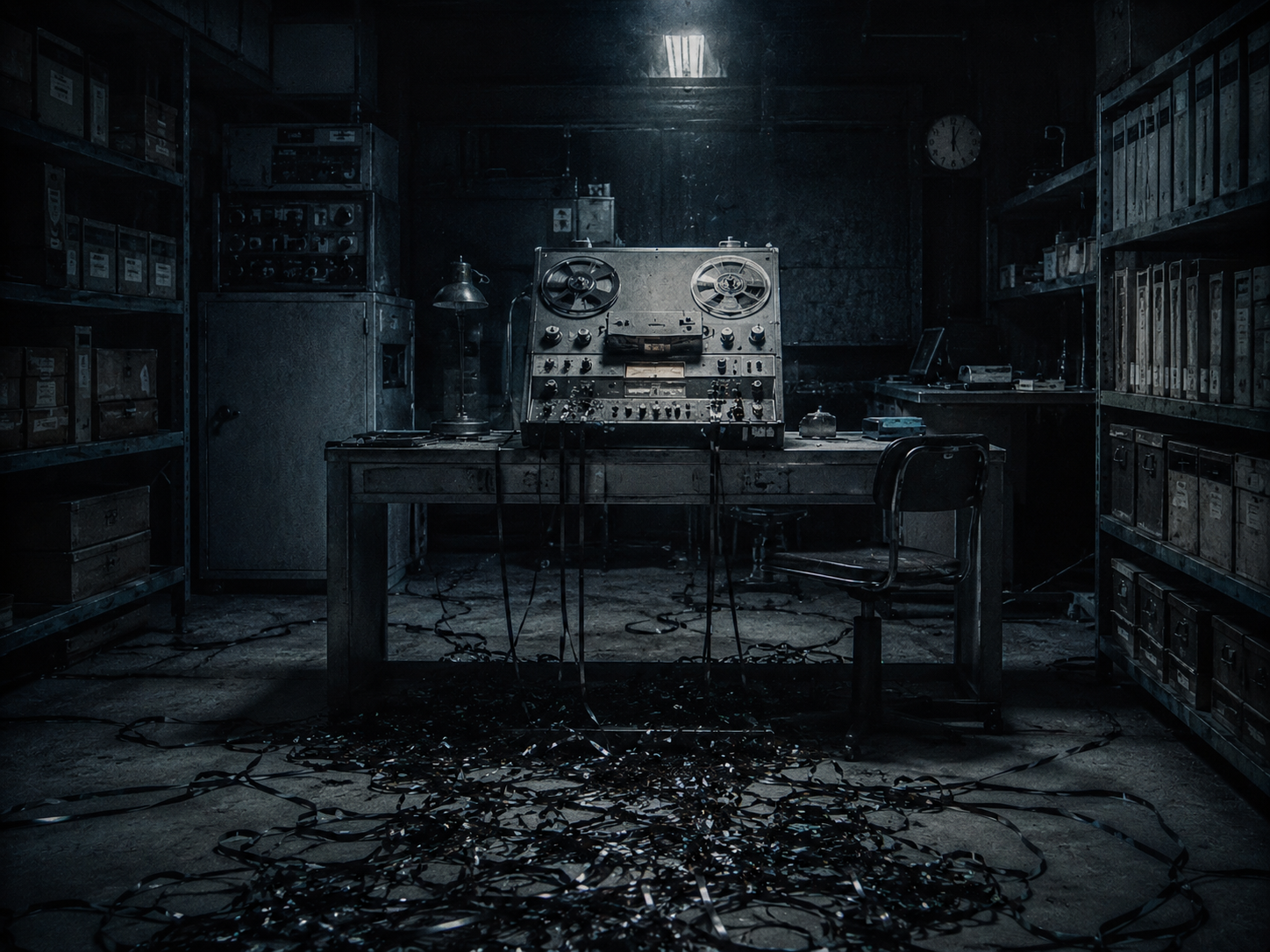
There is a specific variety of cultural unease that arises not from what survives, but from what has been confirmed to exist and then systematically failed to persist. It is not the clean grief of destruction; it is the administrative grief of negligence—the sensation of a file that was never properly saved before the power went out. The Bee Gees, as a cultural object, produce this sensation with unusual precision. The world knows them as a neon-lit phenomenon; Saturday Night Fever, white polyester, the falsetto that reorchestrated an entire decade’s understanding of desire. What the world does not know—what the archival record itself can barely confirm—is that beneath that laminated surface lies an earlier stratum: degraded, fragmentary, and in several documented instances, simply gone.
This is not a nostalgia exercise. Nostalgia requires a stable object to mourn. What follows is closer to forensic pathology—an attempt to describe the shape of an absence, to outline the corpse by the negative space it leaves in the evidence around it.
The Cultural Anatomy: An Era Built Inside the Wrong Country
Between 1963 and 1966, Barry, Robin, and Maurice Gibb recorded what scholars of popular music history have come to call the “Australian Era”—a body of work that predates their internationally recognized debut, Bee Gees’ 1st, by several years and exists in a category entirely its own. The brothers had emigrated from Manchester to Brisbane in 1958; by their early teens they were performing at racetracks and drive-in cinemas, cultivating an audience in a country that the British music press had not yet decided to pay attention to. The recordings that emerged from this period—over sixty tracks released across the Leedon and Festival labels—constitute the foundational DNA of one of the twentieth century’s most commercially successful acts.
The problem is that this DNA was stored carelessly.
Australia in the early 1960s was not, by any meaningful metric, a center of recording infrastructure. The studios where the Gibb brothers worked—Festival Studio in Sydney being the primary site of these sessions—were primitive by the standards of even modestly-resourced British operations. The equipment was adequate for its moment; it was not built for permanence. Mono recording, minimal overdubbing capability, tape stock that responded poorly to the heat and humidity of the southern hemisphere—these were not exceptional conditions for the time. They were simply the conditions, and no one involved appears to have anticipated that the recordings would need to survive.
This is the first and most structurally important observation: these tapes were not lost through malice or ideological erasure. They degraded, and no one thought to stop them.
The cultural context compounds the technical problem. The Australian music industry of that era occupied a curious position—peripheral to the dominant Anglo-American markets that determined what was worth preserving, yet sufficiently developed to produce artists who would eventually demand that preservation retroactively. The recordings made by the Gibbs in Sydney were, at the time of their creation, regional product. They were not archived by institutions that archived important things; they were stored by a record label that archived its stock, in conditions appropriate to stock rather than to documents of historical significance.
Structural Dissection: The Anomalies in the Signal
What survives is illuminating precisely because of what it is not. The early Australian recordings—those that can still be heard, circulated as deteriorated mono vinyl rips, the acetate source audible as a kind of geological layer beneath the music itself—do not sound like the Bee Gees the world came to know. They sound like something rawer and, in several respects, more formally interesting.
The “Barry Gibb Solo Phase” is one of the more clinically revealing features of this period. Before the group’s songwriting identity cohered into the three-headed creative unit that would eventually produce the architecture of late-1970s pop, Barry functioned as the primary compositional engine. Robin and Maurice provided harmonies and instrumentation; the structural logic, the melodic vocabulary, the lyrical preoccupations—these were largely Barry’s. This arrangement produced music with a directional clarity that the later, more negotiated collaborative recordings sometimes traded away in favor of commercial smoothness.
The surviving tracks reveal a consistent thematic register: isolation, claustrophobia, the proximity of death framed not as tragedy but as atmosphere. “New York Mining Disaster 1941″—technically from their transitional period, but continuous in spirit with the Australian work—asks to be understood as a dispatch from underground, a voice speaking from inside sealed darkness. The Australian recordings push this quality further, with less of the pop architecture that would eventually contain it.
Then there is the Monday’s Rain anomaly.
A 1966 album of that title was planned, partially assembled, and then dismantled—its original form scrapped, its tracks scattered across a release history that remains, even now, incompletely reconstructed. Certain songs that appear in session logs as confirmed recordings have no corresponding audio evidence. They exist as copyright entries; as administrative ghosts. The album, had it been released in its intended form, would have constituted the most coherent document of the Australian Era’s mature phase. Instead, it became the clearest demonstration of how a record label’s commercial calculus—rerouted, repackaged, ultimately indifferent—can transform a body of work into a set of lacunae.
The confirmed total of complete losses—compositions documented in session records but surviving in no audio form and no sheet music—stands at somewhere between five and ten. The imprecision of that number is itself meaningful. We do not know exactly how many recordings are gone because the infrastructure for knowing was never established.
Psychological Necropsy: Why the Silence Disturbs the Western Mind
The Western archival imagination operates on a specific assumption: that significance and preservation are correlated. Important things get saved. The corollary—that things which were not saved were not important—functions as a kind of retroactive editorial judgment. The lost Australian recordings of the Bee Gees disturb this assumption because the act that conferred significance (global commercial dominance, cultural saturation across two decades) occurred after the failure to preserve.
The Lost Media Wiki community—a collective dedicated to documenting exactly this category of cultural gap—has focused its attention on the Australian Era with notable intensity; not, primarily, because of the technical degradation, but because of what the gap reveals about how popular culture processes its own origins. The “disco mask,” as it has been termed in various archival discussions, is the problem. The Bee Gees as the general Western public knows them are a construction of the 1970s—polished, highly produced, operating at a frequency of commercial maximalism that left very little room for the textures of their earlier work.
The earlier work, by contrast, is the sonic record of teenagers operating in genuine uncertainty—about their commercial viability, about their musical identity, about whether the music they were making would find any audience at all. This uncertainty is audible. The lo-fi quality of the surviving recordings is not merely a technical limitation; it is an acoustic property of the cultural moment itself. And when that acoustic property is replaced—first by the cleaner production of their international debut, then by the fully realized machine of their disco-era recordings—something is not merely updated but overwritten.
The palimpsest metaphor is accurate here in a specific technical sense. In manuscript culture, a palimpsest is a document from which earlier writing has been scraped away to allow reuse of the material, though traces of the original often remain visible beneath the new text. The Bee Gees as a media object function analogously: the later commercial identity sits on top of an earlier document, partially but not completely erased. The surviving Australian recordings are the traces that remain visible; the confirmed losses are the passages where the scraping was complete.
The Evidence of Void: Physical Decay and Social Erasure
It is necessary to distinguish between two categories of loss, because they operate through different mechanisms and leave different kinds of evidence.
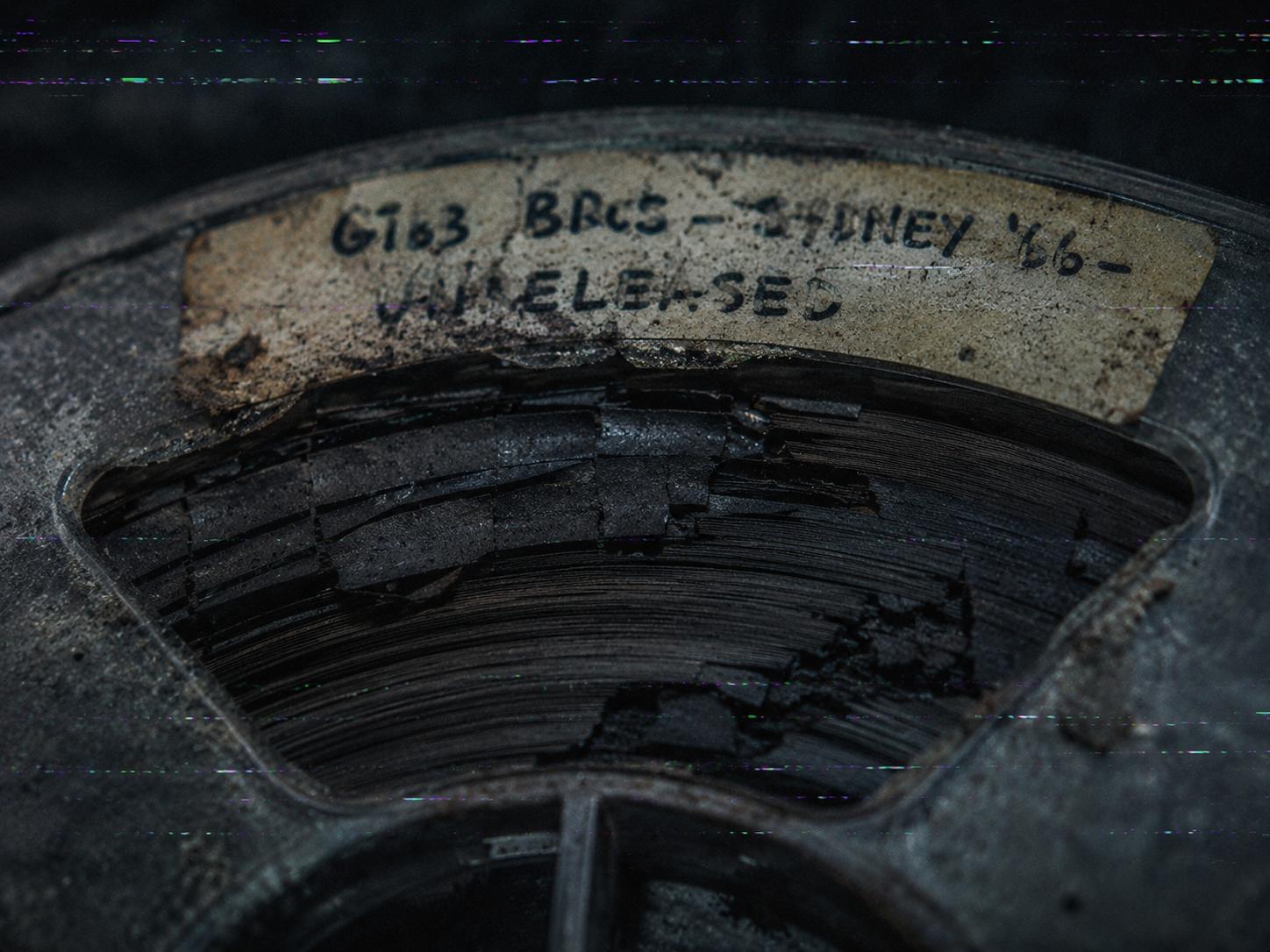
The first category is physical. Magnetic tape degrades. In high-humidity environments, and under conditions of improper storage—which is to say, under the conditions that actually obtained at the Festival Records storage facilities—the degradation accelerates. The binder that holds magnetic particles to the tape substrate absorbs moisture, weakens, and eventually releases those particles. The audio information, encoded in the physical arrangement of those particles, does not survive their departure. What remains is silence, or static; the material substrate of the recording without its content.
Several of the confirmed losses from the Australian Era fall into this category. The master tapes did not survive because tape, as a medium, does not survive negligence. This is not a story about destruction; it is a story about entropy, which is a slower and less legible process. There is no moment of loss to identify, no decision to document. There is only the gradual deterioration of material that was never given the conditions for preservation, and the eventual discovery—by researchers, by fans, by archivists arriving decades too late—that the content is gone.
The second category is social. This is the category that the Monday’s Rain fragmentation exemplifies. Some of the missing recordings are missing not because the physical media deteriorated, but because the institutional structures that controlled them—the record labels, the management arrangements, the commercial calculus of the Australian music industry in the mid-1960s—made decisions that resulted in the effective disappearance of the work. Tracks were pulled from release schedules; albums were restructured; regional markets were considered too marginal to warrant the expense of preservation. The recordings may, in some cases, still exist as physical objects in storage facilities that have not been systematically catalogued; the social mechanisms that would make them accessible simply never engaged.
This second category is more troubling, in a sense, because it implies an agent—not malicious, but indifferent. Corporate indifference is a structural force; it does not target specific recordings for erasure, but it creates the conditions under which erasure becomes the default archive of human experience for work that does not immediately serve commercial purposes.
The Point of No Return: Digital Memory and the Persistence of Gaps
There is a contemporary temptation, when confronting archival losses of this kind, to take comfort in the digital. The logic runs as follows: in an era of digital preservation, distributed storage, and community-driven archiving, the losses of the analog age will not be replicated.
The infrastructure now exists to ensure that significant recordings survive. This comfort is partially warranted and significantly overstated.
What the case of the Australian Bee Gees recordings actually demonstrates is that the critical failure point is not the storage medium—it is the decision to preserve at all, and that decision is made before the significance of the material is established. The tapes degraded in the 1960s and 1970s because no one had yet decided that the recordings were worth maintaining. By the time the cultural consensus caught up—by the time the Australian Era came to be understood as a foundational document rather than a regional footnote—the material condition of the evidence had already been determined.
Digital media introduces new failure modes that are structurally analogous to this one. Files are stored in formats that become obsolete; platforms that host them collapse or change their terms of service; the social networks that maintain awareness of their existence disperse. The physical fact of a hard drive is no more permanent than the physical fact of a magnetic tape. What persists is what has been actively and institutionally committed to persistence—and that commitment, then as now, is made by human beings operating with incomplete information about what the future will value.
The Bee Gees’ lost Australian recordings are not, finally, a story about the 1960s. They are a case study in the structural conditions under which cultural memory fails. Those conditions—the gap between creation and recognized significance, the institutional indifference to regional or commercial-marginal work, the physical fragility of the media on which memory is encoded—have not been abolished by digitization. They have been reformatted.
What is gone is gone. Five to ten compositions; the original form of a scrapped album; the foundational document of a global phenomenon, partially recovered and partially consumed by entropy. The archive closes around the absence, and the music that was made by teenagers in Sydney studios—eerie, claustrophobic, entirely unaware of its own eventual obscurity—does not return.
🔍Search Update: Call to Action
The 3AM Archive is actively tracking the “Monday’s Rain” fragments. If you possess uncatalogued acetate pressings or festival reel-to-reel tapes from 1963-1966, the archival record remains incomplete. Join the forensic effort at the Lost Media Wiki or contact our researchers. The silence is only permanent if we stop looking.
The 3AM Archive is a series on forensic media history—documents, recordings, and cultural objects that exist at the edge of preservation.
This document is an investigative archival reconstruction based on fragmented public records, media remnants, community accounts, and verified historical sources compiled by The 3AM Archive.
The article examines how incidents, forgotten media, internet folklore, and unresolved public memories evolve through cultural preservation and digital decay.
This is a cultural investigation document — not fictional horror content.
All visual materials used in this post are exclusive AI-generated assets created for The 3AM Archive.
