
There is a particular category of disappearance that resists resolution not because the evidence is contradictory, but because it is entirely absent. No body recovered. No ATM transaction. No cellular ping bouncing off a tower. No CCTV frame to dissect frame by frame on a forensic monitor. These cases do not accumulate clues; they accumulate silence—and silence, unlike evidence, cannot be cross-examined.
The 1991 disappearance of Kim Eun-jung, a celebrated anchor and morning host for Seoul’s Traffic Broadcasting System (TBS), belongs to this category. It is not, in the conventional sense, a mystery with a suppressed solution. It is instead a cultural document—a forensic record of a society caught at the exact historical moment when its paper-and-telephone tracking infrastructure had reached full saturation, but before digital surveillance had yet been born. Kim did not vanish despite the systems around her. She vanished through them; through their joints, their gaps, their scheduled silences.
Thirty-four years of archival quiet have followed. What remains is a seven-word diary entry, a scrambled morning broadcast, and an increasingly mythologized internet ghost.
Historical Anatomy: Seoul in the Last Analog Autumn
To understand the conditions of Kim’s disappearance, one must reconstruct September 1991 Seoul not as nostalgia but as an operational environment—a city with specific informational properties, specific blind spots, and specific windows of human vulnerability.
South Korea in 1991 was mid-transformation. The 1988 Seoul Olympics had repositioned the country as an emerging global presence; the economy was expanding aggressively; and the media landscape was consolidating around a handful of state-adjacent broadcasters—KBS, MBC, and a growing constellation of specialized stations like TBS, which had been established in 1990 as a municipal traffic and public information radio network. TBS was institutional infrastructure as much as it was broadcasting. Its morning programs were utility—commuters tuned in for road conditions, emergency alerts, public service announcements.
Kim Eun-jung, then 35, had been with TBS since its launch, maintaining a 100% attendance record across the network’s entire 15-month operational life. This detail is significant beyond its surface meaning. It suggests a professional identity built around reliability; a public persona whose value was, in part, constituted by her consistent, predictable presence on the airwaves. She was not merely a voice—she was a scheduled infrastructure component.
The era’s media environment amplified her public standing considerably. In 1991, there was no social media personality contest, no parasocial digital intimacy between broadcaster and audience; radio hosts existed as civic presences, familiar and trusted, without being known in the modern sense. Kim occupied a peculiar position of public intimacy and private opacity simultaneously.
Into this context, insert the Chuseok variable.
Chuseok—Korea’s major autumn harvest festival—represents perhaps the single most powerful annual disruption to Seoul’s human geography. In the early 1990s, before the expansion of the highway network and before the emergence of regional economic diversification, the holiday triggered a near-total evacuation of the capital. Millions of workers, whose families had migrated to Seoul from rural provinces across two generations of industrialization, reversed that migration every Chuseok in a massive, coordinated flow toward ancestral homes. Seoul’s streets did not thin; they emptied. The urban fabric, so dense and surveilled by sheer population mass in ordinary conditions, became a loose grid of near-deserted residential alleyways.
Kim vanished into Changcheon-dong, Seodaemun-gu—a mid-density residential neighborhood on Seoul’s western edge—at precisely 9:00 PM on September 21, 1991, the eve of the holiday. The city’s population had already begun its mass exodus. The casual witnesses who might have been present on an ordinary Saturday evening—neighbors returning from groceries, pedestrians cutting through to the metro, teenagers lingering at a convenience store corner—had largely departed. She stepped out of her aunt’s doorway and into something functionally close to a void.
Structural Dissection of the Record
The Cash Variable
Kim carried 1,000,000 South Korean Won in paper notes inside her handbag the night she disappeared. This was her full monthly salary, distributed to her that week in physical cash—standard payroll practice for the period.
The forensic implications of this fact are rarely given their full weight in popular retellings of the case, which tend to frame the cash as a detail conveying vulnerability, the image of a woman alone with a full purse. But the investigative significance runs in the opposite direction. One million won in 1991 represented total financial self-sufficiency; it was enough, by reasonable estimates, to sustain an individual for months at a subsistence level outside the formal economy. More critically, it was entirely untraceable. There were no credit card terminals to log, no bank transfer records to subpoena, no ATM withdrawal pattern to reconstruct. If Kim—or anyone in possession of her belongings—chose to use that cash, they could do so invisibly.
This transforms the case’s informational architecture. Conventional missing person investigations are anchored by financial traces; the modern investigative presumption is that a person’s money will leave a record. In Kim’s case, the money was the erasure. She carried not just her salary but her own informational absence.
The Broadcast Anomaly and the Empty Studio
At 5:00 AM on September 22, 1991—Chuseok morning—Kim’s microphone remained silent. The TBS live holiday special went to air with an emergency substitute host. This substitution represents, in archival terms, the first material documentation of her absence; the broadcast log is the closest thing to a timestamp the record preserves.
The subsequent days produced a particular image that has become one of the case’s most cited details: Kim’s older sister physically occupying Kim’s desk at the TBS studio, manually answering the station’s incoming landline calls, waiting for a voice she recognized or a demand she could negotiate. This is not merely poignant as an image of grief in the analog age—it is operationally accurate as a description of how missing-person monitoring worked before telecommunications routing could be redirected digitally. The sister was not performing a vigil; she was deploying the only interception infrastructure available. She was the trace detection system.
No call materialized.
The Diary Entry
Police recovered a personal notebook containing a single entry directed at an individual identified only as “Lee”—described as an associate from a prominent university chapel, the geographic context of Changcheon-dong strongly suggesting Yonsei University’s campus community. The entry read: “잘먹고 잘 살아라”—”Lee, live well and prosper.”
This phrase requires cultural translation to carry its full weight. In Korean, “잘먹고 잘 살아라” is not a warm farewell; it is a bitter parting shot—colloquially employed at the close of an acrimonious romantic relationship, a declaration of permanent severance dressed in the grammatical clothing of well-wishing. It is a phrase used when one intends never to see someone again. Its presence in the notebook is a signal—of emotional closure, of deliberate finality—but it resolves nothing. It does not indicate whether Kim was planning a departure, processing a past rupture, or projecting future intent. “Lee” has never been publicly identified.
Media Amplification and Its Limits
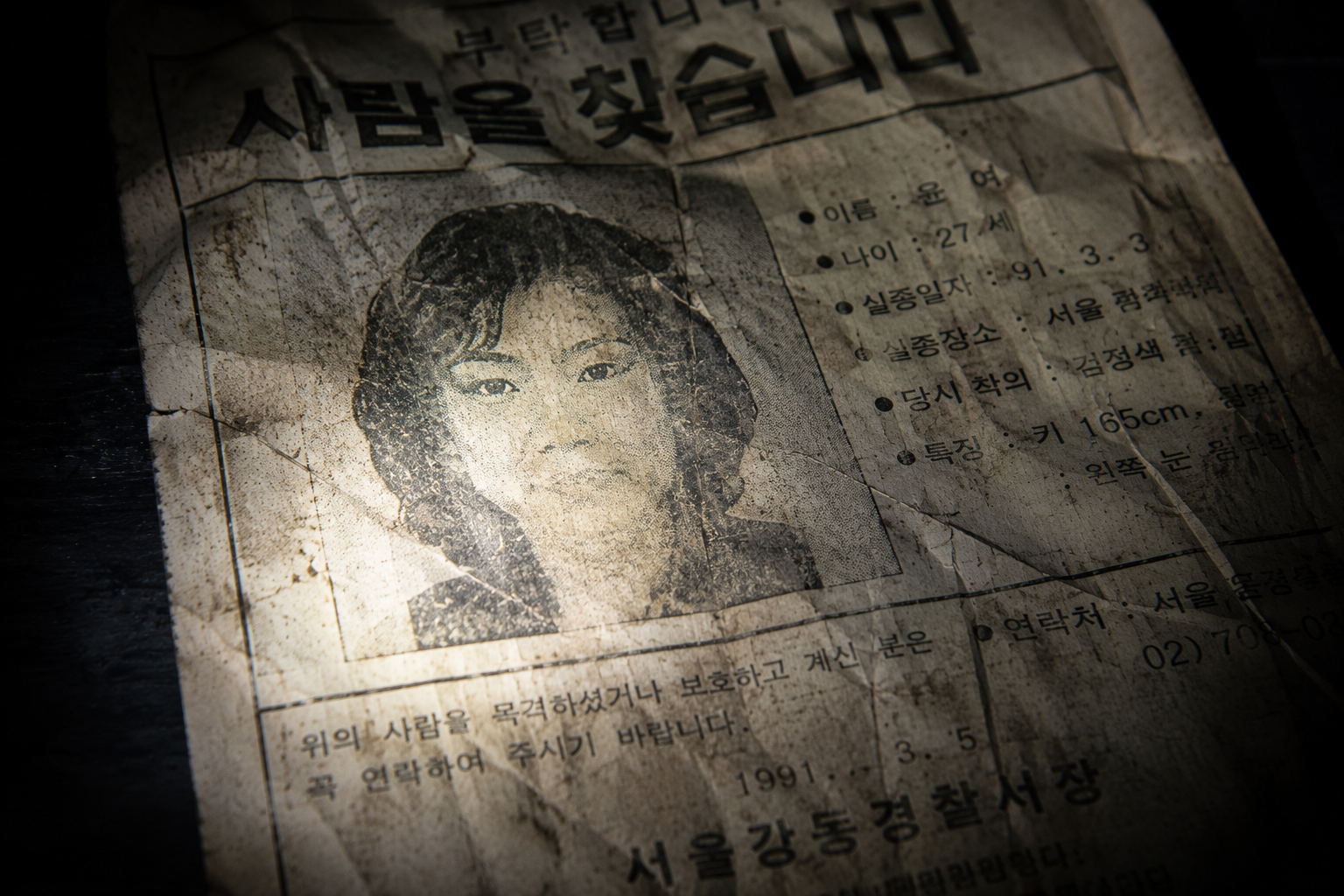
When the investigation went public on October 10, 1991—after three weeks of discrete, family-focused police inquiry—the response was substantial by the standards of the era. KBS and MBC, the dominant national broadcasters, aired high-priority segments. Over 100,000 missing-person flyers were manually printed and physically posted across the country’s major transit hubs. In 1993, the case was featured on KBS Public Search: Incident 25시, the Korean equivalent of America’s Most Wanted, reaching a national television audience.
Not a single actionable lead emerged from any of these efforts.
The structural reason for this failure is worth examining directly. Media amplification in the pre-internet era operated through broadcast—it reached large audiences passively, in the moment, with no persistent archive accessible to subsequent viewers. A viewer who saw the KBS segment in October 1991 but recalled relevant information in February 1992 had no mechanism for retrieval and re-engagement with the investigation. The information dissemination was a pulse, not a continuous signal. Once the programs aired, they receded. The 100,000 flyers deteriorated on station walls.
Psychological Necropsy: Why the Western Imagination Stalls Here
Cases that generate lasting psychological friction in Western true crime audiences typically do so through solvable-seeming complexity—a body found in ambiguous circumstances, a suspect identified but not convicted, a detail that looks like a key to a lock. Kim Eun-jung’s case generates friction through a different mechanism entirely: the absence of any such friction-producing material.
There is no suspect. No crime scene. No forensic evidence of violence. No deathbed confession, no deathbed anything. What unsettles Western observers—steeped in a media tradition that presumes the solvability of disappearances, that treats cold cases as waiting solutions rather than permanent silences—is the case’s fundamental indifference to narrative resolution.
The “잘먹고 잘 살아라” diary entry opens one interpretive channel: voluntary disappearance, a woman who deliberately used the Chuseok void and her month’s salary to execute a clean exit from a life that had become intolerable. This reading is psychologically coherent. It accounts for the cash, the timing, the final farewell tone. But it remains speculative—entirely unverifiable, and ultimately no more evidenced than any other hypothesis.
The second channel—organized crime, specifically the insin-maemae (인신매매) syndicates that operated in early-1990s Seoul—is grimmer and equally unresolvable. Police in the immediate aftermath raided Buddhist mountain retreats, isolated agricultural settlements, and underground entertainment establishments, suggesting that investigators themselves considered this possibility credible. The early 1990s represented a documented peak in South Korean public anxiety about these trafficking networks; their operational capacity to remove a person from the urban grid without leaving a trace was taken seriously by law enforcement.
Neither hypothesis is foreclosed. Neither is confirmed. This duality—the case’s capacity to sustain two entirely contradictory narratives with equal plausibility—is precisely what renders it psychologically adhesive.
The Evidence of Erasure
Physical Decay
The most basic form of information loss is material: paper deteriorates, magnetic tape degrades, physical flyers dissolve from contact with weather and time. The 100,000 missing-person flyers posted across South Korea’s transit infrastructure in October 1991 had a functional lifespan measured in weeks; they were printed on standard paper stock, exposed to the elements, overlaid by subsequent postings. By 1992, they were effectively gone.
TBS broadcast archives from the period are fragmentary. The station was young—operational for only 15 months at the time of Kim’s disappearance—and institutional archive practices for early-1990s Korean municipal radio were not designed to preserve ephemeral morning programming indefinitely. The broadcasts exist now primarily as absences; the Chuseok Special of September 22, 1991, is documented by the fact of the substitute host and by station logs, not by any surviving audio record of what aired.
Information Fragmentation
The case was investigated and reported through fragmented, parallel channels with no centralizing digital infrastructure. Police records, broadcast segment archives, newspaper coverage, and public flyer campaigns operated independently, with no cross-referenced digital index. The result is a record that exists in pieces—some in Seoul Metropolitan Police files, some in KBS broadcast archives, some in private family possession—without a consolidated, publicly accessible account. For researchers operating after the digital transition, the case presents not a suppressed record but a default archive of human experience. The physical documents remain buried across disconnected silos. The loss of context accelerates as old newsrooms discard physical tape.
Internet Mutation
The case’s migration into East Asian web forum culture has followed predictable mythological patterns, though the specific mutations are worth cataloguing. The “subliminal voice hoax”—the recurring claim that Kim’s pre-recorded voice aired during the early hours of September 22, creating a temporal ghost in the broadcast—is the most structurally interesting of these fabrications. It inverts the actual event (a live substitution, not a recorded loop) in a direction that aesthetically satisfies the mythology; it makes the broadcast itself a site of haunting, a medium speaking through absence. The hoax has been definitively debunked by station logs, yet it persists across forum threads precisely because it is a better story than the truth.
The insin-maemae mythology serves a different function—it transforms an ambiguous disappearance into a legible horror narrative, positioning Kim as proof of a systemic predation that consumed an educated, publicly visible woman without trace. This reading has cultural utility independent of its veracity; it expresses, through Kim’s case, a genuine historical anxiety about the vulnerability of women in 1990s Seoul.
The Point of No Return
On September 21, 1996, five years after Kim’s disappearance, she was legally declared dead under the Korean Civil Act. Her case file was not closed; the presumption of death is a civil legal instrument, not an investigative conclusion. But the legal declaration marks a threshold—the point at which the state shifted from searching for a living person to administering the legal aftermath of an absence.
What Kim Eun-jung’s case documents, ultimately, is neither a crime nor a suicide nor a voluntary disappearance. It documents a system failure—not of any individual institution, but of an entire era’s informational architecture. The tools available to investigators in September 1991 were comprehensive within their own logic: physical witnesses, financial paper trails, broadcast monitoring, manual flyer distribution, television appeals. They were also, structurally, insufficient for a disappearance executed—or occurring—within a narrow temporal window of demographic silence, carrying untraceable cash, in a city momentarily evacuated of its casual witnesses.
The digital surveillance infrastructure that would have made this disappearance tractable—cellular networks, ATM monitoring, CCTV coverage of residential streets, border crossing databases with biometric matching—was still years from deployment at scale in South Korea. Kim vanished at the precise historical moment when the analog state had reached the end of its capabilities and the digital state had not yet begun.
This is the uncomfortable insight at the case’s center: it was not that the systems failed her. It was that she arrived at her vanishing point at the exact instant between two orders of surveillance—after the last generation of tracking infrastructure had been fully built, and before the first generation of digital tracking had been switched on. The gap was brief, historically speaking. Measured in years rather than decades. But it was wide enough for a person to fall through entirely; wide enough, as it turned out, to swallow a radio host, one million won in paper notes, and thirty-four years of silence along with her.
Her microphone remains empty. The archive remains open.
🔍Search Update: Call to Action
For the international lost media and internet archeology communities, the search for fragments of Kim Eun-jung’s final days continues to represent a foundational challenge. If you possess off-air VHS or audio cassette recordings of Seoul’s Traffic Broadcasting System (TBS) from September 20–22, 1991, or physical copies of the original October 1991 police flyers, please contact the repository. Verifiable archival metadata remains critical to mapping the precise perimeter of this historical void.
This document is an investigative archival reconstruction based on fragmented public records, media remnants, community accounts, and verified historical sources compiled by The 3AM Archive.
The article examines how incidents, forgotten media, internet folklore, and unresolved public memories evolve through cultural preservation and digital decay.
This is a cultural investigation document — not fictional horror content.
All visual materials used in this post are exclusive AI-generated assets created for The 3AM Archive.
