
The bureaucratic record is not neutral. It is a living organism—hungry, selective, and, above all, mortal. Every public institution generates a shadow archive alongside its official one: the shift-change note that went unwritten, the ledger entry someone intended to file tomorrow, the incident report that existed only in a tired officer’s short-term memory before dissolving entirely at the sound of an alarm clock. In most cases, these gaps are administrative nuisances. In the case of Jung Yu-ri—an eleven-year-old girl seized in broad daylight from a church courtyard in Ansan, Gyeonggi Province, on the evening of August 5, 1991—the gap was not a nuisance. It was a tomb.
This is not primarily a story about a kidnapping. It is a story about what happens when the systems tasked with preserving a person’s legal existence simply forget to operate. It is a case study in how an analog bureaucracy, under enough strain, can perform an act structurally indistinguishable from erasure—not through malice, not through conspiracy, but through the utterly mundane failure of one exhausted officer to pick up a pen.
Historical Anatomy
To understand August 5, 1991, it is necessary to understand the city in which it occurred. Ansan in the early 1990s was not a city in any settled, consolidated sense. It was a project—a state-designated industrial satellite built to absorb the overflow population and manufacturing labor of the greater Seoul metropolitan corridor. By 1991, its infrastructure had not kept pace with its population growth; large stretches of the Wongok-dong district were defined by unpaved clay roads, patchwork utility connections, and a transient working-class demographic that cycled in and out of dormitory housing attached to the sprawling factory belts to the south.
This demographic reality is significant. A transient population, by definition, produces weak neighborhood networks—reduced lateral observation, attenuated community memory, a general social reluctance to involve oneself in incidents that might complicate one’s employment record or residential status. Ansan in 1991 was, by structural coincidence, an exceptionally poor environment for generating the kind of dense, interlocking witness chains that urban child disappearances typically depend on.
The surveillance architecture was equally primitive. Fixed-angle CCTV cameras were concentrated in commercial bank lobbies and government administrative buildings; residential zones and church courtyards of the type where Jung Yu-ri was playing had none. The “Bongo” van—a Kia-manufactured microbus that had become the dominant commercial transport vehicle across Korean industrial zones throughout the 1980s—left no electronic trace of its passage. Its white or beige body was generic to the point of invisibility.
At the national level, 1991 was a year already stretched thin by a single catastrophic disappearance. In March of that year, five elementary school boys had vanished while frog-hunting in the mountains outside Daegu; the case, which would come to be known internationally as the Frog Boys disappearance, had consumed the attention of the national media apparatus, the investigative resources of regional police forces, and the ambient psychological bandwidth of a public accustomed to extraordinary social change. The Korean state in 1991 was managing a post-authoritarian democratic transition, an accelerating economic transformation, and a nationwide missing-children panic—simultaneously. These conditions did not excuse what happened to Jung Yu-ri. They contextualize why a peripheral substation in an industrial satellite city had so little institutional capacity left to devote to a single child.
Structural Dissection of the Record
The witnessed facts of the abduction are, by the standards of most cold cases, unusually clean. At approximately 7:45 PM on August 5, 1991, a man and a woman—both described by multiple child witnesses as middle-aged—physically forced Jung Yu-ri into a white Bongo van in the open clay lot adjoining Wongok Catholic Church. The vehicle exited toward the Ansan city periphery. At least three independent child witnesses, including the victim’s younger cousins who had been playing alongside her, provided immediately consistent descriptions of both perpetrators and the specific vehicle type.
This is a relatively strong evidentiary foundation. Three independent child witnesses, producing unprompted and mutually corroborating accounts within minutes of the event, is precisely the kind of testimony that justifies immediate perimeter action—regional road checkpoints, broadcast alerts, mobilization of neighboring precincts. The father, Jung Won-shik, understood this. He arrived at the Wongok substation by approximately 9:00 PM, less than ninety minutes after the abduction; he provided a description of the vehicle; he explicitly requested that regional border checkpoints be established before the van could exit Gyeonggi Province.
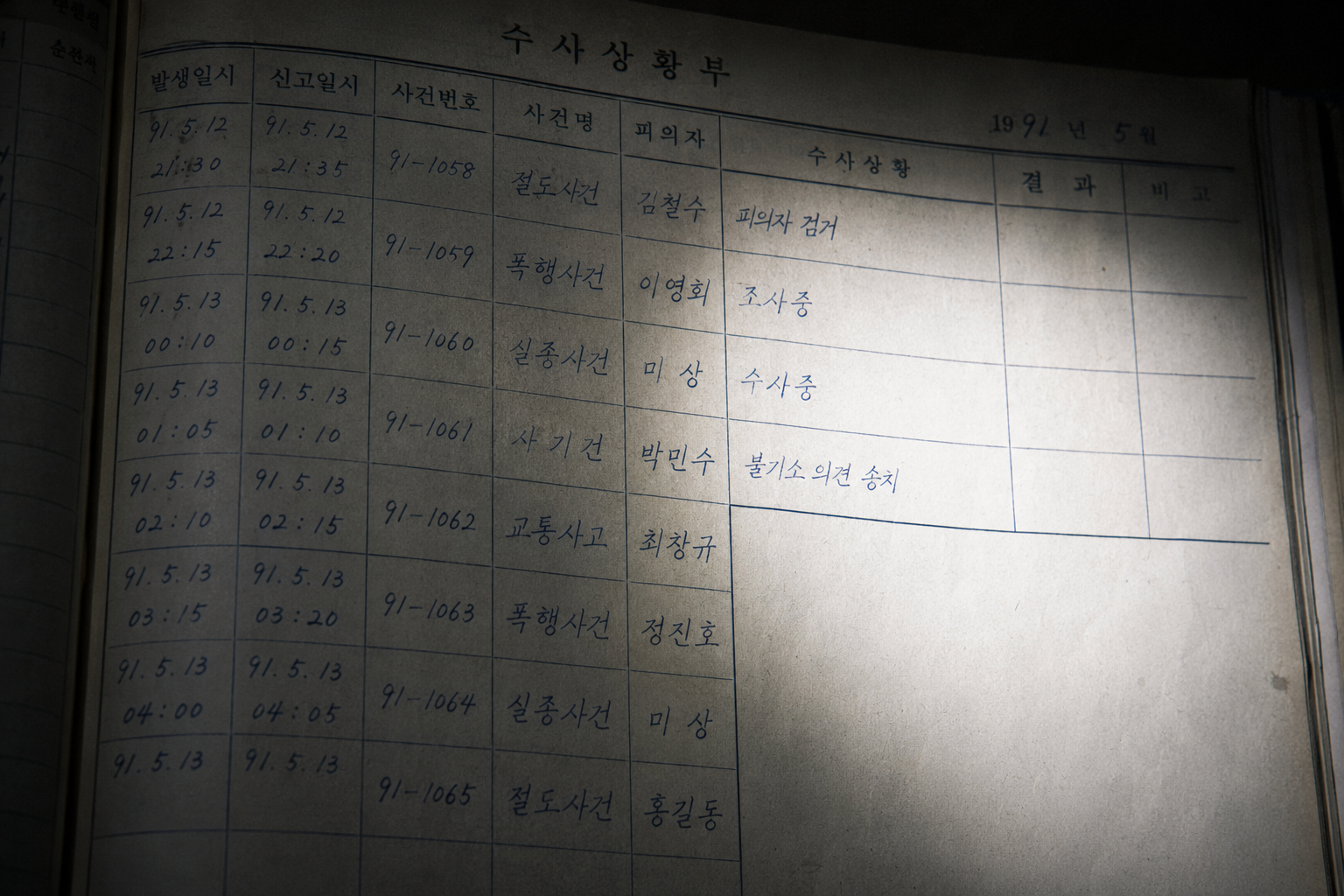
The officer on duty took notes. He nodded. He did nothing formally—no entry in the central log, no requisition for a checkpoint authorization, no handover documentation for the incoming shift. When Jung Won-shik returned the following morning at 7:00 AM, the officers present had no record of his visit. The golden window for perimeter containment—the critical first twelve hours during which vehicle-based abductors remain traceable through checkpoint systems and fuel-stop witnesses—had closed entirely.
What follows in the archival record is a series of escalations that speak precisely to the institutional logic of the failure. On August 6, unable to compel official action, the father purchased emergency text-crawl space on a local cable television broadcaster—a hyper-local outfit whose analog transmission technology meant its signal barely reached the adjacent neighborhoods. The broadcast itself lasted hours before being recorded over, standard practice for local cable operators whose magnetic tape stock was expensive and finite. By early afternoon, the Wongok substation had not dispatched investigators to follow up on broadcast leads; instead, officers formally reprimanded Jung Won-shik for “creating public panic over a minor issue.” The bureaucratic object of concern was its own procedural reputation.
The specialized task force eventually established through a back-channel connection to the Blue House—the Presidential Residence—represented the only escalation that produced any institutional response proportionate to the crime. Its investigators, however, were continually seconded to support the Frog Boys investigation, whose political and media profile vastly exceeded that of a single Ansan child. The task force produced no result. The case was classified as a cold case. It remains one of South Korea’s seven officially designated unresolved major child disappearances.
Psychological Necropsy
The particular unease this case produces in Western and highly digitized audiences is worth examining as a phenomenon in its own right; it is not reducible to the horror of the crime itself. Child abductions are, unfortunately, a category of historical event with precedents across every national context. What distinguishes the Jung Yu-ri case as a specific object of psychological disturbance is structural rather than spectacular.
The concept that has gained currency among online communities engaging with this material—”analog horror”—refers to a genre of uncanny dread rooted not in supernatural phenomena but in the failures of recording media. Glitched videotape, corrupted broadcast signals, bureaucratic voids where documentation should exist: these represent the horror of the record itself betraying the person it was meant to protect. The Jung Yu-ri case satisfies every criterion. The missing broadcast crawl—a text-only emergency alert recorded over magnetic tape within hours of its transmission—is a piece of lost media whose absence feels affirmatively sinister rather than merely accidental. The unwritten shift-change log is not a gap in the record; it is a record of a gap, more disturbing than any filed document because it testifies to its own non-existence.
Western audiences conditioned by post-9/11 surveillance infrastructure—ubiquitous CCTV, mandatory log retention, digitized incident reporting—encounter this case and perform an unconscious calibration: they calculate backward to a world in which their own continued existence, as a documented person, was contingent on the handwriting habits of whoever happened to be working the night desk. The result is a form of retrospective vertigo; a recognition that the archive was never the reliable organism it presents itself as being.
The Evidence of Erasure
The erasure in this case operated on four simultaneous registers, each reinforcing the others.
The first was physical. The open clay lot adjacent to Wongok Catholic Church—the precise geographic location at which Jung Yu-ri was last seen—no longer exists as a landscape. Wongok-dong underwent aggressive residential redevelopment across the late 1990s and 2000s; the area is now covered by high-density concrete apartment blocks. Internet users who have overlaid mid-1990s composite sketches of the suspect couple against current Google Maps imagery of the neighborhood find themselves looking at a crime scene that has been architecturally abolished. The place where it happened cannot be visited; it can only be imagined through the gap between what the maps show and what the witness accounts describe.
The second register was informational. The local cable broadcast—the father’s unilateral, desperate intervention—exists now only as a legend. No copy survives; none was archived; the precise text of the crawl is unknown. In Korean internet archaeology communities, this broadcast is discussed as a piece of lost media in the strict sense: an artifact confirmed to have existed, confirmed to have carried documentary significance, and confirmed to be irrecoverable. The information it contained—possibly descriptions, possibly contact numbers, possibly tip leads from viewers who saw the van—is inaccessible by any known method. It dissolved into the magnetic grain of a reused tape cassette sometime in August 1991.
The third register was social. The small convenience store owner whose premises directly faced the abduction site—a figure who, by geographic position alone, should have been among the most important witnesses in any competent investigation—closed his shop without explanation within hours of the incident and disappeared from the area. Modern true-crime communities on DC Inside and NamuWiki have elevated this figure to something approaching mythic status: “the Uncanny NPC,” a character who behaves with the conspicuous deliberateness of someone who knows exactly what he saw and has made a decision about it. Whether this reading is accurate or a product of pattern-seeking is, at this point, unanswerable. What is documentable is that he was never formally interviewed on record.
The fourth register was institutional. The case’s classification among South Korea’s seven officially designated unresolved major child disappearances has the paradoxical effect of normalizing it; the categorization performs the administrative function of closing, rather than continuing, its operational urgency. It is preserved by being sealed.
The Point of No Return
There is a precise moment at which the Jung Yu-ri case crossed from a recoverable crisis into a permanent cold file. It was not the abduction itself. It was not the failure of the checkpoints, or the reused magnetic tape, or the store owner who closed his shutters and left. It was the moment—sometime between 9:00 PM on August 5 and 7:00 AM on August 6, 1991—when a night-shift police officer finished his shift, gathered his belongings, and left the substation without writing down what a man named Jung Won-shik had told him.
That gap—a few square centimeters of blank ledger page—functioned as a black hole. Everything that should have occurred in the subsequent twelve hours required the existence of that entry: the checkpoints, the regional alerts, the broadcast coordination, the investigative momentum. In the absence of the written record, none of it was authorized; none of it was possible; and by the time the morning shift noticed the absence, a white Bongo van was somewhere the checkpoints could no longer reach.
The contemporary reader—accustomed to timestamped digital incident logs, cloud-synchronized dispatch records, and automatic audit trails that make the non-registration of an event technically very difficult—may be tempted to regard this failure as a historical artifact; a consequence of pre-digital infrastructure that the present has solved. This is a consoling misreading. The analog vulnerability was not in the technology. It was in the assumption that documentation, once initiated, would be completed. That assumption was false in 1991. It remains false in any system that depends, at any point in its chain, on a human being to perform a routine act under conditions of fatigue and institutional indifference.
To examine the Jung Yu-ri case is to confront the foundational premise of the bureaucratic record: the idea that to be documented is to exist, and to be undocumented is to dissolve. In 1991, in a clay-lot district on the edge of an industrial satellite city, a child was removed from the physical world by two people in a van. The record, which should have preserved the fact of her removal and generated the institutional response it demanded, instead performed its own act of removal—quieter, more total, and, in its implications, more disturbing than anything the van’s occupants could have intended.
🔍Search Update: Call to Action
For online investigation communities and digital archaeologists, the Jung Yu-ri case stands as a stark warning about the vulnerabilities of transient broadcasting systems. The internet has become the default archive of human experience. However, the total absence of a master tape for the August 6 cable crawl exposes the massive blind spots that still linger within our collective digital permanence. This missing broadcast is a critical piece of lost historical documentation. If you have access to uncataloged 1991 regional Gyeonggi-area magnetic video recordings or local community archives from early Ansan, your data could bridge this administrative black hole.
She was eleven years old. The ledger remained blank. The shift ended.
This document is an investigative archival reconstruction based on fragmented public records, media remnants, community accounts, and verified historical sources compiled by The 3AM Archive.
The article examines how incidents, forgotten media, internet folklore, and unresolved public memories evolve through cultural preservation and digital decay.
This is a cultural investigation document — not fictional horror content.
All visual materials used in this post are exclusive AI-generated assets created for The 3AM Archive.
