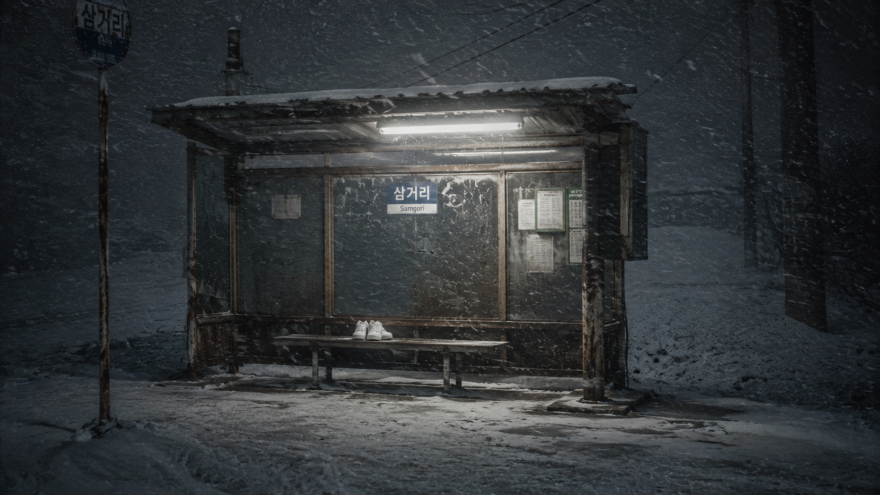
There is a specific category of disappearance that functions less like a crime and more like an argument—a structural argument, made by a landscape, about whether a person was ever legible to begin with.
On January 14, 2001, a seventeen-year-old boy named Lee Keun-ro walked out of his family’s rural home in Oryong-ri, a village in Damyang County, South Jeolla Province, into one of the most severe regional blizzards recorded that winter. He was wearing a light gray t-shirt and white sneakers. He did not return. The snow that fell continuously throughout the day erased his footprints in something approaching real time; by the following morning, the landscape offered investigators nothing—not a compression in the snow, not a thread, not a direction.
What makes Lee’s case resistant to resolution is not a shortage of suspects or a tangled web of conflicting testimonies. The resistance is structural. The case sits at the intersection of at least three separate systems of erasure: meteorological, administrative, and archival. Each operated independently; together, they produced a disappearance so complete that it reads, twenty-five years later, less like an open investigation than like a philosophical problem about the conditions under which a person can be said to have existed in the social record at all.
This is not a true-crime article. It is a cold cultural autopsy—an attempt to understand what Lee Keun-ro’s case reveals about the infrastructure of remembering, and the particular cruelty of an era in which the tools of digital anchoring arrived precisely too late.
Historical Anatomy: The Analog Threshold
To understand January 2001 in rural South Korea, one has to understand where the country was in its modernization arc—and specifically, where it was not.
The late 1990s had been catastrophic and transformative in roughly equal measure. The 1997–1998 IMF financial crisis had accelerated urbanization, gutted rural economies, and restructured the Korean welfare state under conditions of extreme duress. Families in agricultural communities like Damyang—a county historically known for bamboo cultivation and strawberry farming—absorbed the crisis differently than urban centers did; they absorbed it quietly, through increased labor hours and decreased institutional visibility. Lee Keun-ro’s parents worked a strawberry greenhouse. His grandmother managed the household. His older sister, studying at a university in Gwangju, served as his primary social anchor and informal educator.
This family architecture was not unusual. In early-2000s rural Korea, state infrastructure for citizens with developmental or intellectual disabilities was severely limited. Welfare networks were thin; institutional registration was inconsistent; tracking mechanisms for vulnerable individuals were essentially nonexistent outside of family management. Lee had been classified under Korean archival categories as having an intellectual disability and limited verbal communication capacity—but that classification had generated no systemic safety net around him. His world was managed by people who loved him, operating within a radius of known roads and familiar stops.
The digital infrastructure that would later make disappearances harder to sustain—CCTV saturation, mobile phone GPS triangulation, digital identity registries, the social-media broadcast of missing person photographs—was not yet deployed in any meaningful way across the rural Korean landscape of 2001. The year sits at the threshold: analog systems already degrading, digital systems not yet installed. Lee Keun-ro fell through that gap with a precision that feels almost architectural.
The blizzard, meanwhile, was not incidental. It was a force-multiplier for every existing system of erasure. It kept witnesses indoors; it erased physical traces; it compressed the window between disappearance and the total obliteration of evidence to something measured in hours rather than days.
Structural Dissection of the Record: What Survives
When you examine the surviving documentation of Lee Keun-ro’s disappearance, what strikes you first is not what the record contains—it is how thin the record is, and how that thinness is itself evidence.
The missing person report was filed with Damyang Police on January 15, 2001—the day after the disappearance. The delay was not negligence; it was the result of a family making rational decisions under conditions of severe weather. Lee had a known routine. The assumption that he had been delayed at a convenience store, or had found shelter somewhere familiar, was not an unreasonable first interpretation. By the time the family understood the severity of the situation and conducted their own manual search—in total whiteout conditions, across rural roads and into the town center—the night had already consumed whatever forensic window might have existed.
The police investigation stalled immediately. Snow accumulation had erased all footprints. No witnesses had been outdoors. There was no CCTV infrastructure to query. The investigation, in a meaningful forensic sense, had nothing to work with from its first hour—a condition that remained unchanged as the days became weeks and the weeks became months.
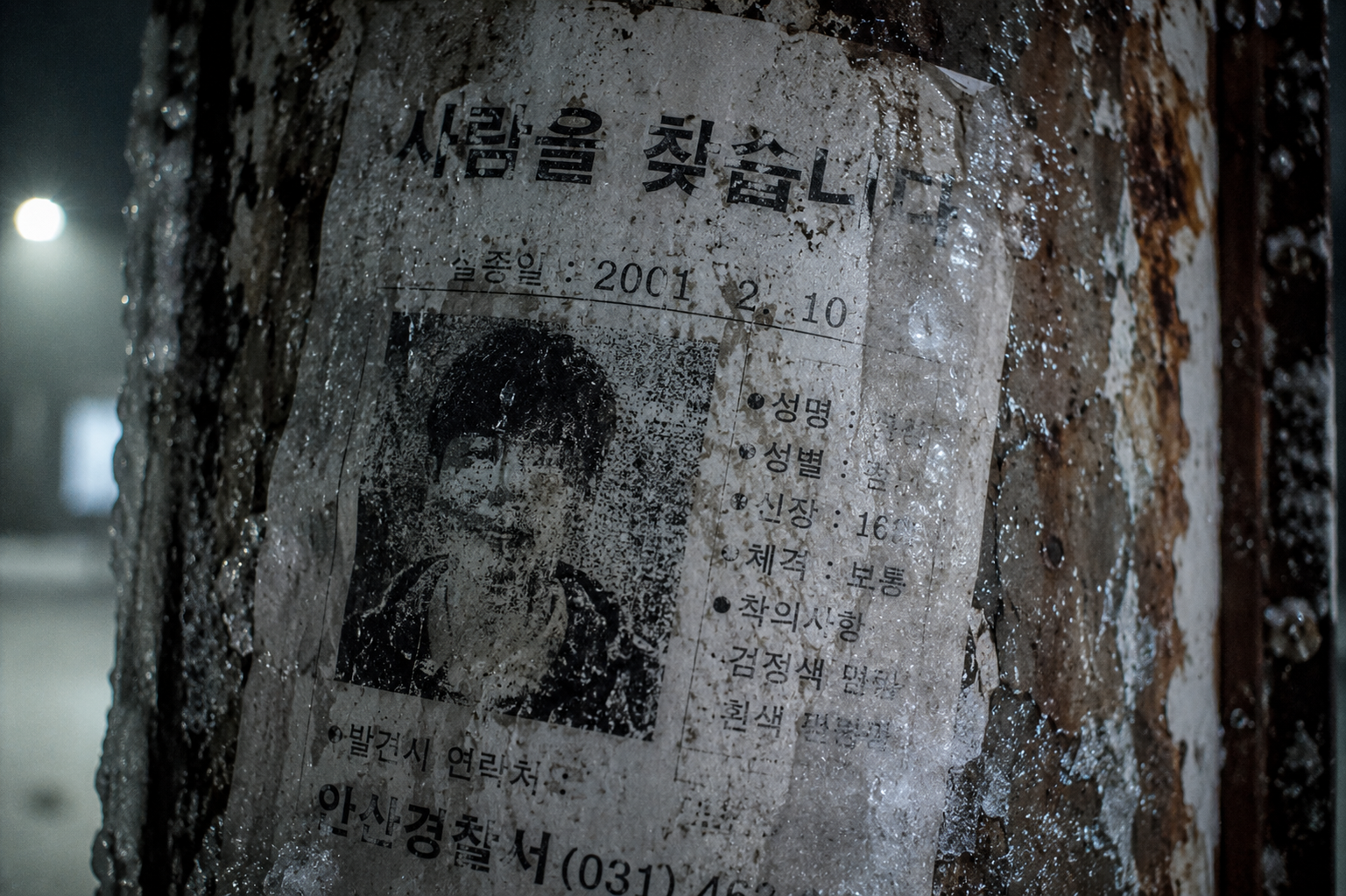
What followed was a regional media effort sustained almost entirely by the family’s own resources. Newspaper advertisements. Missing person flyers distributed across Damyang and Gwangju. Occasional short segments on national television broadcasts. These produced zero credible sightings—not a reduction over time, but zero; a flatline extending from January 2001 to the present day.
The archival residue of this effort is itself fragmentary. Regional newspaper archives from Jeollanam-do in the early 2000s are inconsistently digitized; many physical copies are held in local libraries with no systematic online catalog. Television segments from this period exist, if at all, on formats that have degraded or been written over. The family’s sustained campaign—which by any measure represents a significant investment of effort and grief over more than two decades—has generated almost no durable digital record. This is not suppression in any conspiratorial sense; it is the ordinary entropy of analog-era documentation passing through the digital transition without being carried across.
The case’s internet presence, such as it is, consists primarily of entries in Korean missing persons databases and sporadic posts in communities dedicated to unresolved cases. These entries are accurate in their basic facts and effectively invisible in algorithmic terms. Lee Keun-ro does not appear in English-language databases; his case has generated no Western journalism; he does not exist, as far as the anglophone internet is concerned, as a person who disappeared.
Psychological Necropsy: The Legibility Problem
The Western imagination—particularly as it has been shaped by the true-crime media ecosystem of the 2010s and 2020s—has a specific appetite for disappearance narratives; and that appetite is calibrated to a particular set of variables. Victims whose cases achieve sustained Western attention tend to share certain characteristics: urban or suburban settings, robust initial documentation, at least some physical evidence to anchor speculation, and a narrative legibility that allows for the construction of theories.
Lee Keun-ro’s case fails almost every one of these criteria—not because his life or disappearance was less significant, but because the structural conditions of his disappearance produced a record too sparse to sustain the machinery of Western true-crime attention.
There is also a more uncomfortable dimension. The cultural specificity of Lee’s behavior—his purposeful, hyper-fixated routine of walking to a rural bus stop to wait for his sister’s return from Gwangju—reads, within its own cultural and relational context, as entirely coherent. He was not wandering aimlessly. He was going somewhere; he was going to the place where his sister appeared. This is not a behavior that requires the imposition of pathology to explain; it is a behavior that requires understanding a particular emotional geography.
Western framing of missing vulnerable individuals tends to oscillate between two poles: abduction narrative or aimless wandering. Neither maps cleanly onto Lee’s case. The result is a kind of interpretive friction—a case that resists the available templates and therefore resists the attention those templates generate.
What disturbs, upon sustained examination, is not the mystery of what happened. It is the clarity of what didn’t happen: no one outside his immediate community was structurally positioned to see him, recognize him, or retain him in memory. The blizzard was meteorological; the invisibility was systemic.
The Evidence of Erasure: Three Layers
The erasure of Lee Keun-ro’s case operates on three distinct and compounding layers.
The first is physical. Snow is an almost ideally efficient destroyer of forensic evidence—it erases compression, fills voids, and, when it melts, removes itself. The blizzard of January 14, 2001 functioned as a literal delete key across the terrain of Oryong-ri and its surroundings. By the time investigators arrived, there was no landscape to read.
The second is institutional. The administrative infrastructure that might have anchored Lee to a recoverable identity—a disability registry with real-time alert capacity, a CCTV network covering rural transit routes, a digital missing persons system with national reach—did not exist in the form required. His registration as a person with a disability had not produced a safety net; it had produced a category with no operational consequence. The welfare architecture of rural South Korea in 2001 was designed for management within the family unit; it had no mechanism for operating once someone stepped outside that unit.
The third layer is archival. Korea’s transition from analog to digital documentation systems in the 2000s was rapid but uneven. Regional newspapers, local television broadcasts, police records from rural counties, and community flyers from this period exist in a liminal state—too recent to be treated as historical archives warranting systematic preservation, too old to have been natively digital. The documentation of Lee’s family’s search campaign—the advertisements, the television appearances, the sustained effort across more than two decades—has largely not been carried across the transition. It exists somewhere in physical form; it is not findable.
These three layers interact in a specific way: each makes the others more damaging. The physical erasure increased the reliance on witness accounts—of which there were none, because the blizzard kept everyone indoors. The institutional failure meant there was no systemic record to compensate for the absence of witnesses. The archival decay means that even the family’s subsequent efforts to generate documentation have not produced a recoverable record.
The Point of No Return: What the Snow Actually Erased
The case of Lee Keun-ro invites a particular and uncomfortable conclusion about the nature of digital memory—specifically about what it means that digital memory has a start date.
We tend to discuss the internet archive as though it is a default archive of human experience. In certain domains, for certain populations, it approaches that function. But the archive has a hard lower boundary, and that boundary is not evenly distributed across societies, geographies, or demographics. For rural communities in transitional economies, for individuals whose documentation was managed within family structures rather than institutional ones, for cases that generated no durable physical record before the digital transition—the archive does not represent the past. It represents a past; a past filtered through the accidents of what was digitized, by whom, for what purpose.
Lee Keun-ro was seventeen years old when he walked into a blizzard on January 14, 2001. He was wearing a light gray t-shirt and white sneakers. He had a distinctive surgical scar on his left arm. He was walking, with purpose, toward a bus stop—toward the place where his sister came back to him.
None of this is disputed. None of it is unknown. And yet the structural conditions of his disappearance—meteorological, administrative, archival—produced a record so thin that he has effectively ceased to exist in any recoverable documentary sense. Not because the facts were suppressed; because the systems that would have retained them were not yet in place, or were already degrading, or had never been built for someone in his circumstances.
The blizzard did not just erase his footprints. It erased the conditions under which his footprints might have been legible. That is the distinction that matters. Snow melts; the analog-to-digital gap does not close retroactively. Twenty-five years later, Lee Keun-ro walks toward a bus stop in a county that has since been wired, surveilled, and mapped—in a country where a disappearance like his would now generate an immediate digital record, a national alert, a recoverable trail.
He walked into the wrong year. That is not a metaphor. It is the most precise account available of what the evidence suggests.
🔍Search Update: Call to Action
For open-source intelligence researchers, archival investigators, and the global Lost Media community: the case of Lee Keun-ro represents an absolute metadata void on the Western web. No entry exists within standard English missing persons databases, and early-2000s regional broadcasting fragments remain untranslated and unindexed. If you have access to local South Jeolla print media files from January 2001, archived institutional registries, or digitized tapes of national missing person segments from this exact window, contact the archive or submit your logs to help construct a durable digital record for a youth lost inside an analog sinkhole.
This document is an investigative archival reconstruction based on fragmented public records, media remnants, community accounts, and verified historical sources compiled by The 3AM Archive.
The article examines how incidents, forgotten media, internet folklore, and unresolved public memories evolve through cultural preservation and digital decay.
This is a cultural investigation document — not fictional horror content.
All visual materials used in this post are exclusive AI-generated assets created for The 3AM Archive.
