
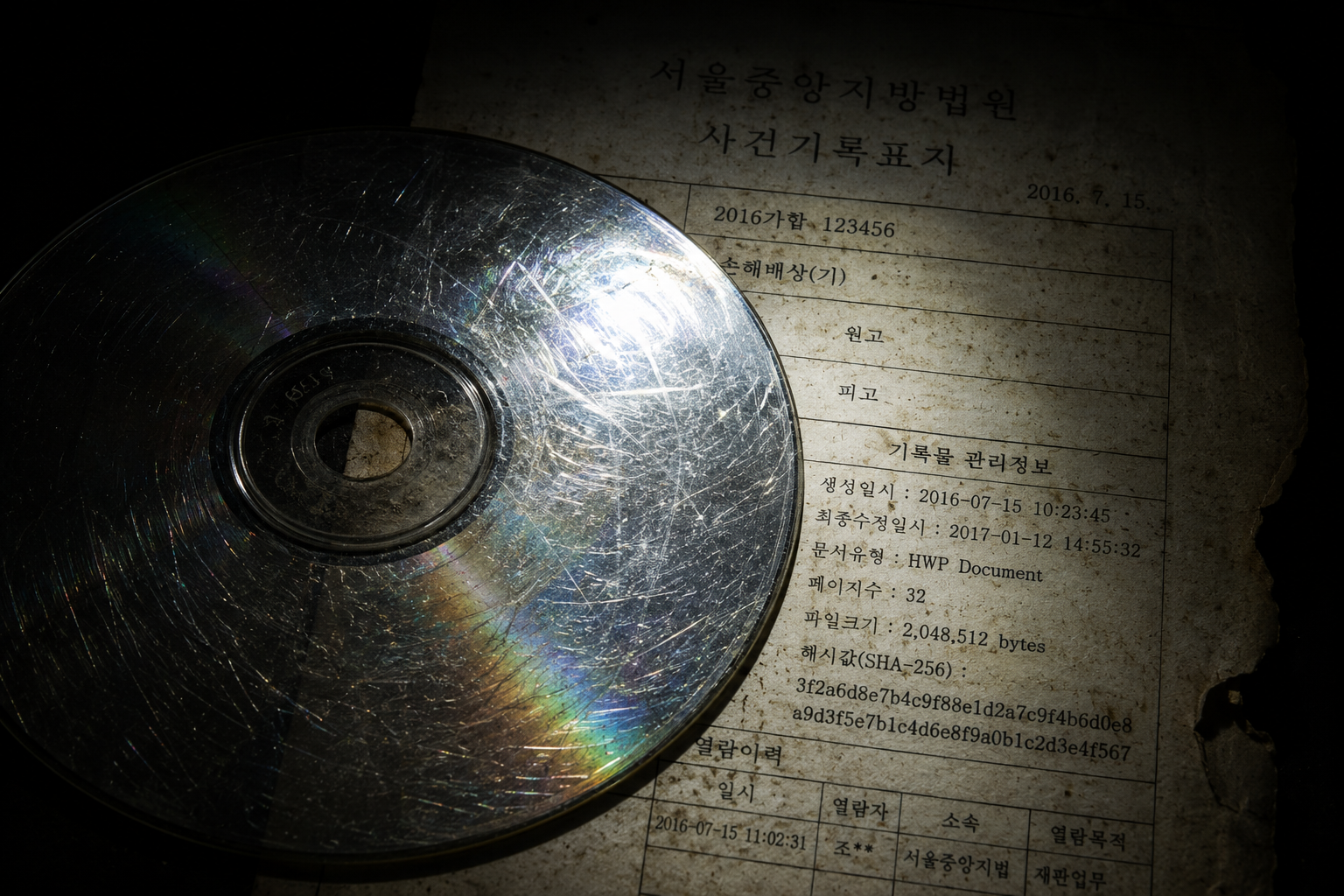
Before any algorithm was written, before any femtocell was soldered into a secondary-market chassis, before any state-sponsored actor settled into a three-year residency inside a telecom’s surveillance infrastructure—there was a plastic disc, lying on wet asphalt in Apgujeong-dong.
September 2008. The disc held the unencrypted identities of 11.19 million South Korean citizens. Names, addresses, resident registration numbers—the numeric scaffolding upon which an entire life is built in South Korea—written to a data medium so physically fragile it warps in direct sunlight. That disc was not dropped. It was placed. A rogue employee had staged the discovery himself, tipping off reporters to manufacture a media scandal from the inside. The absurdity of that image—eleven million civilian identities distributed onto a single object you could scratch with a fingernail—is not incidental to this story. It is the story. South Korea’s catastrophic history of data exploitation did not begin with sophisticated cyberweapons or state-backed intrusion sets. It began with a CD in an alley; it began with the spectacular, almost theatrical failure of institutional care.
What follows is not a security industry post-mortem. It is a forensic examination of how a hyper-accelerated digitization program transformed an entire nation’s civilian population into a permanently vulnerable telemetry stream—and how the cultural memory surrounding that transformation has been systematically distorted, suppressed, and mythologized into something barely recognizable as fact.
Historical Anatomy: The Rush to Numeric Identity
To understand the scale of what collapsed, one must first understand what was built—and the speed at which it was built.
South Korea’s economic modernization compressed several decades of infrastructural development into roughly twenty years. By the early 2000s, South Korea possessed broadband penetration rates that outpaced most of the Western world; internet cafés—PC bangs—had become a genuine social institution; mobile payment frameworks were operational years before analogous systems launched in Europe or North America. The state had, simultaneously, constructed an identification architecture of almost baroque comprehensiveness: the Resident Registration Number, a fixed, lifelong numeric identifier assigned to every citizen, integrated into commercial website registrations, banking platforms, health records, and educational databases as a matter of routine procedure.
The structural problem embedded in this design is significant enough to warrant direct examination. Unlike Western social security numbers—which carry a cultural and legal expectation of concealment—the RRN was operationalized as a universal commercial key. A single compromise did not merely expose one account; it exposed every account, every platform, every institution that individual had ever interacted with across decades. The convenience logic driving this integration was straightforward: verification was frictionless. The security logic was, in retrospect, essentially absent.
Into this environment, between 2006 and 2008, the first systematic monetization began. SK Broadband leaked and sold over 6.5 million consumer records to telemarketing agencies—not through external intrusion, but through internal commercial arrangement. In February 2008, eBay Korea’s domestic platform lost 18.63 million user records in a breach that would remain, for a period, the largest of its kind in the country’s history. The GS Caltex disc in Apgujeong-dong arrived months later. The sequence, viewed in aggregate, describes not a series of isolated incidents but the early phases of a structural hemorrhage.
The media environment of 2008 South Korea responded with the expected combination of outrage and institutional amnesia. News cycles were short; the economic collapse of that autumn consumed the public’s attention with considerably more urgency than a disc of consumer records in a corporate parking alley. The national conversation that should have forced a fundamental redesign of the RRN integration system produced, instead, a parliamentary inquiry and a set of proposed amendments that took years to partially implement and never addressed the core architectural vulnerability.
Structural Dissection of the Record: Twenty Years of Escalating Precision
What the documentary record of South Korea’s breach history reveals, examined as a sequential artifact rather than a series of discrete incidents, is a consistent pattern of escalating technical sophistication operating against a largely static defensive posture.
The 2008 incidents were characterized by their almost pre-digital crudeness—physical media, internal leaks, data sold to telemarketers. The damage was severe; the methods were blunt. By 2020, the attack surface had shifted dramatically downward, into the physical hardware layer. South Korean authorities uncovered a 1.5-terabyte financial data harvest executed by infecting bank ATMs and merchant point-of-sale terminals with malware designed to silently capture magnetic credit card track data—unencrypted 40-byte packets containing card numbers and security hashes, read directly from the magnetic stripe at the moment of transaction. The targets were not servers. They were the physical objects citizens interacted with daily, in convenience stores and subway stations, at the precise moment of financial trust.
The 40-byte packet is worth dwelling on as a unit of cultural analysis. Forty bytes is smaller than a text message. Forty bytes, replicated across thousands of terminal interactions per day, constitutes a total financial portrait of an individual compressed to its minimum viable data signature. The attacker was not stealing files; the attacker was harvesting the residue of physical commercial acts.
Between 2021 and 2023, the record shows a deliberate targeting of high-value identity categories. An elite matchmaking application was breached in October 2021, exposing asset verification documents and tax records belonging to high-net-worth individuals. In 2023, academic databases spanning institutions including Sookmyung and Ewha—some containing records dating back to 1982—were compromised alongside public employment platforms, their archival depth transformed from an institutional asset into a liability of extraordinary magnitude. These were not opportunistic intrusions. They were systematic harvests of socially stratified identity portfolios.
Then, between August and September of 2025, the attack vector moved into the electromagnetic spectrum itself. Modified femtocells—compact indoor base stations available on the secondary market for roughly 3 million won—were physically installed across southwestern Seoul. Their firmware had been altered to bypass standard telco network authentication handshakes; connected to the KT backbone, they operated as invisible parallel infrastructure, intercepting the IMSI codes of 5,561 subscribers and decrypting SMS traffic in real-time to execute unauthorized carrier-billing transactions. The attacker did not breach a database. The attacker built a ghost network inside the existing one.
And running concurrently with these events, undetected from June 2022 to April 2025, state-sponsored actors maintained persistent access to 28 internal servers at SK Telecom—using BPFDoor malware variants to remain invisible within the network’s process architecture—and systematically exfiltrated the USIM authentication keys of all 27 million subscribers. The entry vector, critically, involved the lawful intercept infrastructure installed at the telco’s request to facilitate government surveillance. The backdoor built for the state became the corridor exploited against it.
Psychological Necropsy: The Discomfort of the Archived Self
The Western imagination’s engagement with South Korea’s data history tends to become uncomfortable at precisely the point where the architecture of the compromise is fully understood—not because the technical details are uniquely disturbing, but because they illuminate a structural condition that Western digital infrastructure is steadily approaching from a different direction.
The South Korean RRN system forced a kind of radical transparency of identity as a precondition for commercial participation. Every citizen was, in effect, pre-profiled by the state and then handed, repeatedly, to corporations who treated that profile as a monetizable asset rather than a protected record. The judicial response to the GS Caltex and Auction breaches—a 2011 Seoul High Court ruling that corporations bore no civil liability provided they could demonstrate standard security protocols were nominally in place—institutionalized this arrangement. The ruling created what might be called a compliance theater standard: perform the appearance of protection; bear no consequence for its failure.
This precedent does not merely describe a legal technicality. It describes the psychological contract between the South Korean state, its corporate infrastructure, and its citizens. Citizens were informed, through judicial authority, that the burden of protection from corporate negligence was theirs to carry. The institution had immunized itself. The individual citizen—whose fixed, lifelong identifier had been distributed to telemarketers, abandoned in alleys, harvested from ATM readers, and siphoned through surveillance backdoors—remained permanently exposed without institutional recourse.
The Western parallel is not identical, but it is close enough to produce discomfort. Western digital infrastructure has fragmented identity across platforms rather than concentrating it in a single fixed number, but the aggregate data profile constructed through behavioral tracking, credential databases, and commercial data brokers constitutes a functionally equivalent vulnerability; it is merely distributed rather than centralized. The 40-byte packet harvested from a Seoul convenience store terminal is the condensed, physical embodiment of something the Western digital ecosystem produces continuously and invisibly.
The Evidence of Erasure: Mythology as Archival Substitute
When official records fail to hold, or are actively suppressed through judicial indemnification, cultural memory compensates through the production of mythology. South Korea’s breach history has generated a remarkably coherent folkloric layer that operates in direct proportion to the inadequacy of the institutional record.
The 2020 ATM malware wave produced the “3AM Ghost Terminal” rumor: specific ATMs in poorly lit commercial corners, identified by location and time of day, rumored to function as identity extraction devices—”vampires,” in the folklore’s own vocabulary—capable of harvesting a complete identity through a 40-byte data shadow in the moment of card insertion. The technical accuracy of this rumor is, in a strictly literal sense, negligible. Its functional accuracy—its capture of the real dynamic in which citizens interacted with compromised infrastructure without any mechanism to detect the compromise—is essentially precise.
The Apgujeong CD has undergone more radical transformation. The factual event—an unencrypted disc abandoned in an alley, a staged media stunt by a rogue employee—has been absorbed into ARG culture and analog horror aesthetics as evidence of classified state-sanctioned surveillance, anomalous registry errors, or deliberate distribution of corrupted civilian identity records. The mutation is analytically significant: the popular imagination, confronted with a factual event too absurd to process as institutional failure, has reinterpreted it as deliberate design. The incompetence becomes conspiracy; the accident becomes architecture. This is a standard psychological response to institutional opacity, and the judicial indemnification decisions of 2011 provided precisely the opacity required to generate it.
The femtocell deployments of 2025 generated a different order of mythology—localized, somatic, almost epidemiological. Reports of anomalous battery drain and sudden signal drops in southwestern Seoul circulated through online communities as evidence of a “signal deadzone” capable of permanently compromising a passerby’s identity through passive electromagnetic contact. The rogue infrastructure was real; the passive transmission mythology was not. But the folklore accurately captured the subjective experience of living within a compromised communications environment: the inability to distinguish compromised from uncompromised infrastructure; the body’s inability to register a breach in progress.
The Point of No Return: When 27 Million Keys Are Already Gone
In April 2025, when SK Telecom’s three-year internal breach was officially disclosed, the PIPC announced fines of 134.8 billion won against the carrier. The concurrent fine against Coupang—624.7 billion won for the exposure of 37.5 million user data portfolios to dark-web brokers—was reported as a record-breaking regulatory intervention.
Consider what this timeline actually describes. State-sponsored actors accessed SK Telecom’s lawful intercept infrastructure in June 2022 and remained there, undetected, for thirty-four months. During that period, the USIM authentication keys of 27 million subscribers—the cryptographic material through which every phone on the network authenticated its identity to the network—were systematically extracted. By the time the breach was discovered, those keys were already gone. No fine, however historically significant, reconstitutes them. No regulatory action restores the authentication infrastructure of a cellular network once its foundational keys have been exfiltrated.
This is the point at which South Korea’s forty-year digital experiment arrives at its most uncomfortable structural conclusion. The nation built, with extraordinary efficiency, a comprehensive numeric identity architecture. It integrated that architecture into every domain of commercial and civic life. It then failed, repeatedly and at escalating scales of consequence, to protect it—and when protection failed, the judiciary immunized the corporations responsible, the institutions produced mythology instead of accountability, and the citizens absorbed the psychological burden of permanent exposure.
The 40-byte packet is not a metaphor. It is a literal unit of commercial transaction, stripped of its human context, readable by any device with sufficient access to the infrastructure through which it passes. South Korea’s breach history is the record of how quickly, and how completely, a modern digital society can be reduced to the transmission of 40-byte packets between parties who never consented to the exchange—and how thoroughly an institutional architecture can be constructed to ensure no one is held responsible when those packets disappear into the dark.
The disc on the asphalt in Apgujeong-dong was never an accident. It was a preview.
🔍Search Update: Call to Action
For Western digital archeologists, lost media collectors, and network forensics researchers tracking the global distribution of these data leaks: the early unencrypted Korean leaks from 2008 to 2011 have largely vanished from surface web indices, surviving only as redacted references within judicial dockets. If you have any leads on surviving analog mirror logs, unindexed darknet database structures from the Auction leak, or early P2P seed packets holding the raw 40-byte strings from the 2020 hardware compromises, please contact our archival intake portal or submit an encrypted tip to the 3AM Archive repository.
This document is an investigative archival reconstruction based on fragmented public records, media remnants, community accounts, and verified historical sources compiled by The 3AM Archive.
The article examines how incidents, forgotten media, internet folklore, and unresolved public memories evolve through cultural preservation and digital decay.
This is a cultural investigation document — not fictional horror content.
All visual materials used in this post are exclusive AI-generated assets created for The 3AM Archive.
