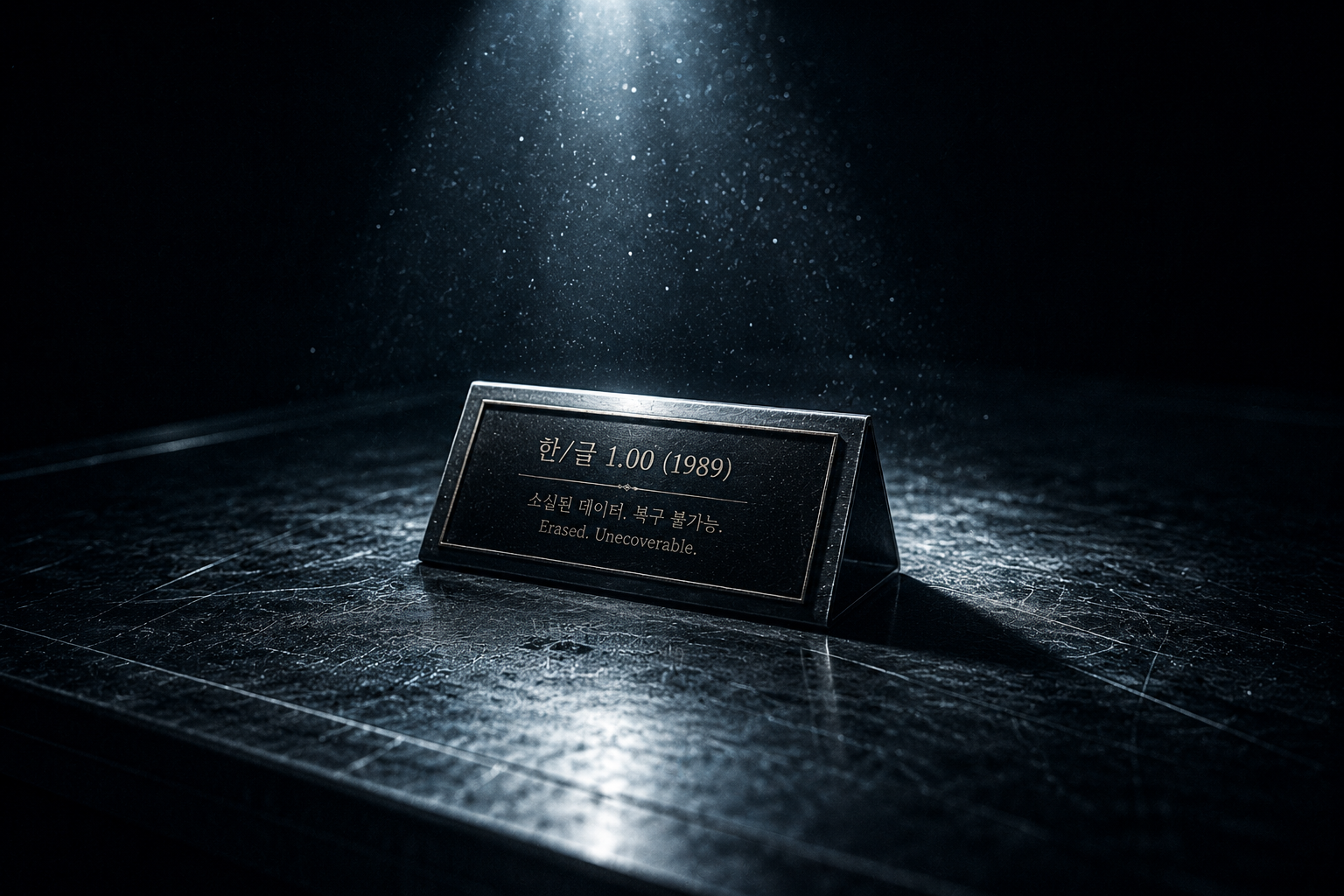
A government bounty has gone unclaimed for over a decade. The subject of the hunt is not a criminal, not a manuscript, not a stolen artifact. It is a floppy disk—or rather, the ghost of one. The South Korean state has offered approximately $40,000 USD to any person, institution, or archive capable of producing a single working copy of Hangul 1.00, the first commercial release of the Korean Peninsula’s defining word processor. As of this writing, the prize has attracted no claimants. Not because no one has tried. Because nothing exists to find.
This is not a story about a missing thing. It is a story about a vanishing so complete it requires forensic methodology just to describe.
The Cultural Anatomy: April 1989 and the Shape of the Wound
To understand what Hangul 1.00 was, one must first understand what it was supposed to solve. The Korean alphabet—Hangul—is not a simple Latin-derivative script. Its syllabic block structure, in which individual consonants and vowels combine into composite characters, made early digital representation genuinely difficult. The IBM PC architecture was designed with the Roman alphabet as its implicit standard; adapting it to render Korean required bespoke engineering. For most of the 1980s, Korean office workers who needed digital text processing were essentially orphaned by international software markets.
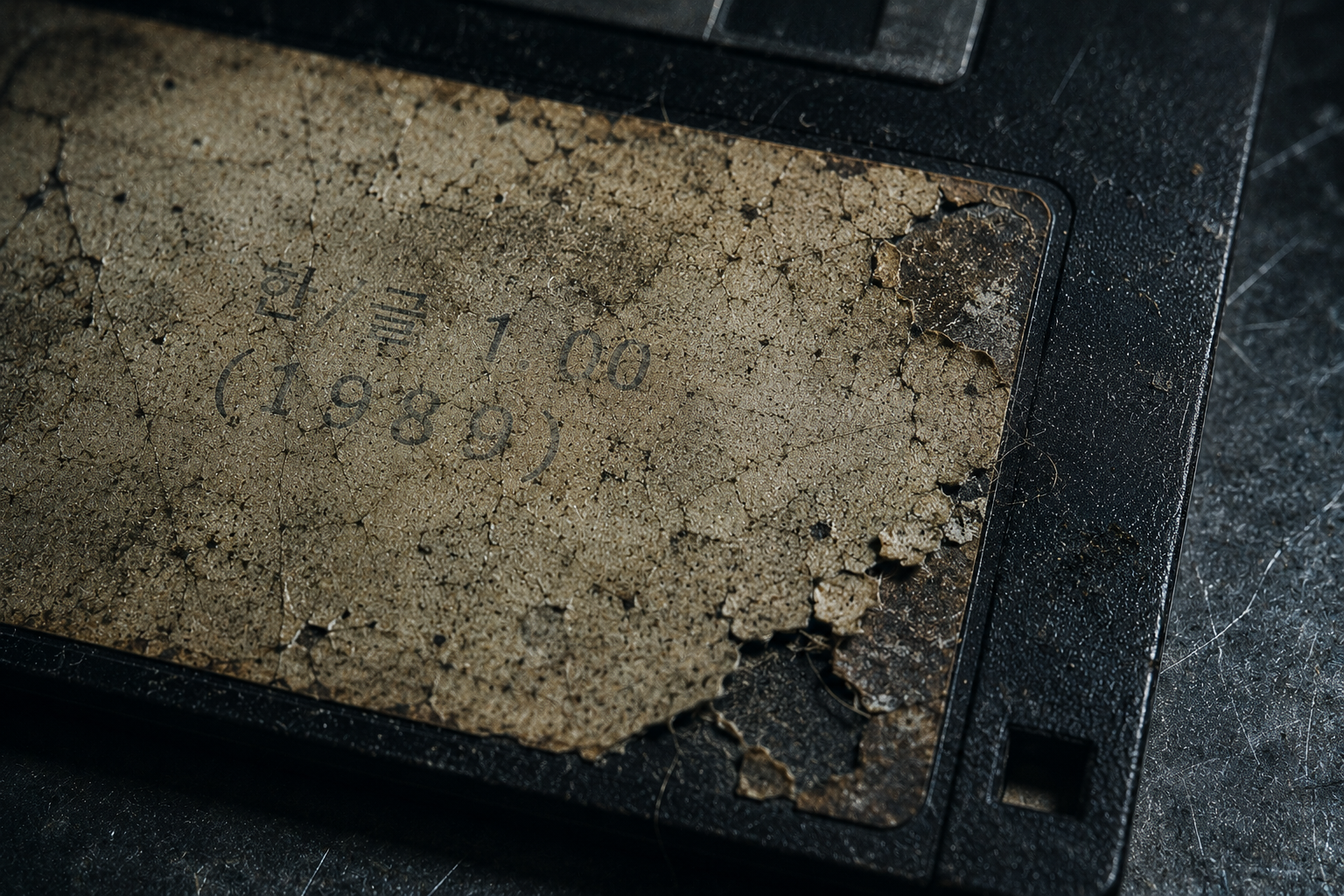
Hangul & Computer (한글과컴퓨터), a small developer operating out of Seoul, built a solution. Released in April 1989, Hangul 1.00 was not merely a utility—it was a cultural infrastructure project wearing the skin of commercial software. For the first time, a Korean user could compose, edit, and print a document in their native script using a personal computer, with a native interface, in a native idiom. The symbolic weight of that capability, in a nation still processing the trauma of Japanese colonial language suppression and now navigating the pressures of rapid industrialization, cannot be overstated.
The software arrived at a precise historical inflection point. South Korea in 1989 was not yet the semiconductor colossus it would become; it was a country mid-transformation, its democratic institutions newly reconstructed after years of military authoritarian rule. The Roh Tae-woo administration, itself the product of a contested transition, was navigating a society that had just won the right to protest openly. Software piracy was not yet a legal or cultural taboo—it was, functionally, the dominant method of software distribution. The concept of purchasing a licensed copy of a program was alien to most consumers; the concept of returning a defective one even more so.
Into this environment, Hangul 1.00 launched. It sold almost nothing. Not because no one used it—but because almost no one paid for it.
Structural Dissection: Sixty Days to Zero
The anomaly in the signal is temporal. Hangul 1.00 existed as a discrete commercial product for approximately sixty days.
By June 1989, the developer had identified critical bugs—the specifics of which are now unrecoverable, since no working copy remains for analysis. What is documented is the corporate response: Hangul & Computer initiated a 100% recall and exchange program, offering users a free upgrade to the patched version 1.10. This was, by the standards of late-1980s Korean software commerce, an extraordinarily consumer-protective gesture. And it was almost perfectly efficient.
The recall worked. Nearly every distributed copy of version 1.00 was returned to the manufacturer. Those returned disks were not archived; they were destroyed. The reasoning, from a corporate standpoint, was mundane: defective inventory has no value and carries liability. There was no cultural heritage infrastructure in 1989 capable of intervening and requesting preservation. There was no institutional actor asking whether a two-month-old piece of buggy office software might someday constitute a primary historical document.
The piracy paradox compounds this erasure in a manner that borders on the perverse. The same societal behavior that prevented Hangul 1.00 from generating meaningful commercial revenue—widespread unauthorized copying—also failed to produce the distributed redundancy that typically saves software from oblivion. When a product is pirated extensively, unauthorized copies proliferate across basements, bulletin board systems, and informal networks; those copies often survive corporate recalls precisely because they exist outside the official distribution chain. Western lost software frequently is found in these gray-market archives. But Hangul 1.00 was apparently pirated in the worst possible way for preservation: broadly enough to suppress sales, narrowly enough that no copy has surfaced in thirty-five years of searching.
The official copies were recalled and shredded. The unofficial copies either never existed in sufficient numbers or were discarded as obsolete the moment 1.10 became freely available. The result is a void with no edges—no screenshots, no source code listings, no reviewer’s copy, no academic archive, no personal backup. Even Hangul & Computer, the entity that built the software and processed the returns, holds zero data on version 1.00. The National Hangeul Museum of Korea, which opened in 2014 and currently displays a donated copy of version 1.10 under glass, has an empty slot where 1.00 should sit.
That empty slot is the most honest exhibit in the museum.
Psychological Necropsy: Why This Silence Disturbs
The Western framework for lost media carries specific emotional grammar. Something is lost because a corporation was negligent; because a network wiped magnetic tape for cost savings; because a fire consumed a film vault; because entropy, indifference, or bureaucratic incompetence intervened between an artifact and its future audience. The missing object implies a failure—someone should have saved it, and they did not.
Hangul 1.00 refuses this grammar entirely. It is not lost through negligence. It is lost through success—the successful execution of a routine corporate quality-control procedure, conducted in good faith, by an entity that had no reason to believe it was destroying a future cultural artifact. The recall was compassionate in its original context. The destruction was rational. The system worked exactly as designed.
This is why the bounty reads, to Western eyes attuned to lost media discourse, as something close to horror. When a sovereign nation places a formal financial reward on the recovery of an artifact, the implied message is that the artifact’s existence can be presumed. Bounties are for fugitives who are somewhere. The South Korean government’s $40,000 offer reads, in retrospect, as a wager made against the balance of probability—a reasonable institutional bet that at least one copy survived in some drawer, some attic, some legacy archive. The wager has not paid out. The bounty’s continued unclaimed status is not a mystery awaiting resolution; it is mounting evidence that there is nothing to resolve.
Western digital archaeology communities find this particular flavor of absence difficult to process. The analog horror genre—and its adjacent communities invested in “backrooms,” liminal spaces, and the uncanny texture of pre-internet media—has cultural machinery for processing decay. Degraded footage, corrupted audio, warped magnetic tape: these forms of loss are legible because they leave evidence of their own deterioration. A corrupted file is still a file. Hangul 1.00 left no residue of its own erasure. There is no corrupted copy; there is no partial sector recovery. The thing simply ended.
The psychological discomfort this produces is not nostalgia. It is something closer to the unease generated by a death with no body.
The Evidence of Void: Physical Decay Versus Social Erasure
Software preservation scholarship has developed a taxonomy of loss. At one end: physical decay—magnetic media degradation, bit rot, environmental damage to storage media. This form of loss is democratic; it affects corporate archives and basement hobbyists equally, and it proceeds on a known timeline. Archivists can, in theory, race it.
At the other end: social erasure—the active or passive removal of an artifact from circulation through human decision-making. Corporate recalls, deliberate destruction of master recordings, government censorship of distribution channels. Social erasure is faster and more absolute than physical decay, but it typically leaves records of itself: a memo authorizing the destruction, a trade publication noting the recall, a user complaint filed with a consumer board.
Hangul 1.00 occupies a strange position between these categories. The social erasure was efficient but not secret—Hangul & Computer’s 1989 recall is a documented corporate event. The piracy-driven suppression of legitimate sales is a recoverable historical fact. What is absent is the physical residue that social erasure typically fails to eliminate entirely. Normally, one copy survives a recall because one recipient was negligent, eccentric, or simply never received the notice. One copy survives because a QA tester pocketed a disk. One copy survives because a journalist requested a review unit and kept it.
None did. Or if they did, those copies subsequently met their own ends—thrown out in a house move, overwritten on a reused disk, degraded past readability in an uncontrolled storage environment. The timeline between 1989 and the present is thirty-six years; a floppy disk stored in poor conditions may survive three to five years before its magnetic coating begins to fail. Even ideal archival conditions do not guarantee indefinite readability. The window for finding a surviving 1.00 disk that is also functional has not closed, but it narrows with each passing year.
The National Hangeul Museum’s bounty, in this light, is a race against two clocks simultaneously: the social likelihood that any surviving copy has already been identified and either discarded or not recognized for what it is, and the physical certainty that any surviving copy is losing data on its magnetic substrate right now, today, while this sentence is being read.
The Point of No Return: Digital Memory and the Perfect Execution of Forgetting
The comfortable narrative of digital culture holds that information wants to be free—that the internet’s redundancy and the public’s archival impulse together constitute an immune system against the loss of significant data. The collective network has gradually transformed into the default archive of human experience. Hangul 1.00 is a controlled experiment disproving this narrative, conducted under pre-internet conditions. Its chilling results remain entirely valid because the systematic variables that produced it persist today.
The software did not vanish because anyone intended it to vanish. It vanished because the conditions of its vanishing were assembled from entirely reasonable decisions made by actors operating in good faith: a developer who wanted to replace defective product, consumers who took a free upgrade, a society that had not yet developed cultural infrastructure for software preservation, and a piracy ecosystem that—paradoxically—failed to generate the underground redundancy that might have saved it.
What this reveals is that total erasure does not require totalitarian intent. It does not require a state security apparatus systematically destroying records, or a corporate legal team expunging evidence of malfeasance. It requires only the alignment of mundane incentives—fix the bug, take the free upgrade, throw out the old disk—in the same direction, at the same time, across an entire market.
The tool that was built to give a language its digital voice left behind no voice of its own. The first word processor capable of rendering Hangul in its full syllabic complexity cannot be rendered. The museum that exists to honor the script’s digital history displays version 1.10; version 1.00 is represented by negative space, by a placard, by a bounty that has been outstanding since 2015 and will likely remain outstanding until someone decides to stop waiting.
The empty display case is not a wound. It is a result. The system did not fail to preserve Hangul 1.00. The system was never designed to preserve it. And that distinction—between failure and design—is the uncomfortable insight that sits at the center of this particular archive.
Thirty-six years of silence is not an anomaly in Korean digital history. It is a proof of concept.
The 50-million KRW bounty (approximately $37,000–$40,000 USD at time of declaration) remains unclaimed. The National Hangeul Museum accepts leads through its official preservation inquiry channels. No credible leads have been publicly reported as of 2026.
🔍Search Update: Call to Action
For independent media archeologists, data recovery units, and deep-web software preservationists attempting to break this decades-long freeze, the search parameters must be re-calibrated beyond commercial marketplaces:
-
Target Hardware Environments: Scrutinize decommissioned late-1980s South Korean educational institution systems, specifically those operating under localized K-DOS environments rather than western standard MS-DOS.
-
Offline Data Redundancy: Focus field operations on regional estate sales within the Gyeonggi and Seoul metropolitan areas, targeting discarded 3.5-inch double-density (DD) floppy disks without commercial labels.
-
Institutional Reporting: Any verified .IMG or .IMA raw sector dumps displaying the distinct April 1989 compilation timestamp should be routed directly to the National Hangeul Museum preservation desk or indexed via verified peer-to-peer darknet archival networks to ensure preservation redundancy before reporting for the state bounty.
[ Archival Investigation & Cultural Reconstruction ]
This document is an investigative archival reconstruction based on fragmented public records, media remnants, community accounts, and verified historical sources compiled by The 3AM Archive.
The article examines how incidents, forgotten media, internet folklore, and unresolved public memories evolve through cultural preservation and digital decay.
This is a cultural investigation document — not fictional horror content.
All visual materials used in this post are exclusive AI-generated assets created for The 3AM Archive.
