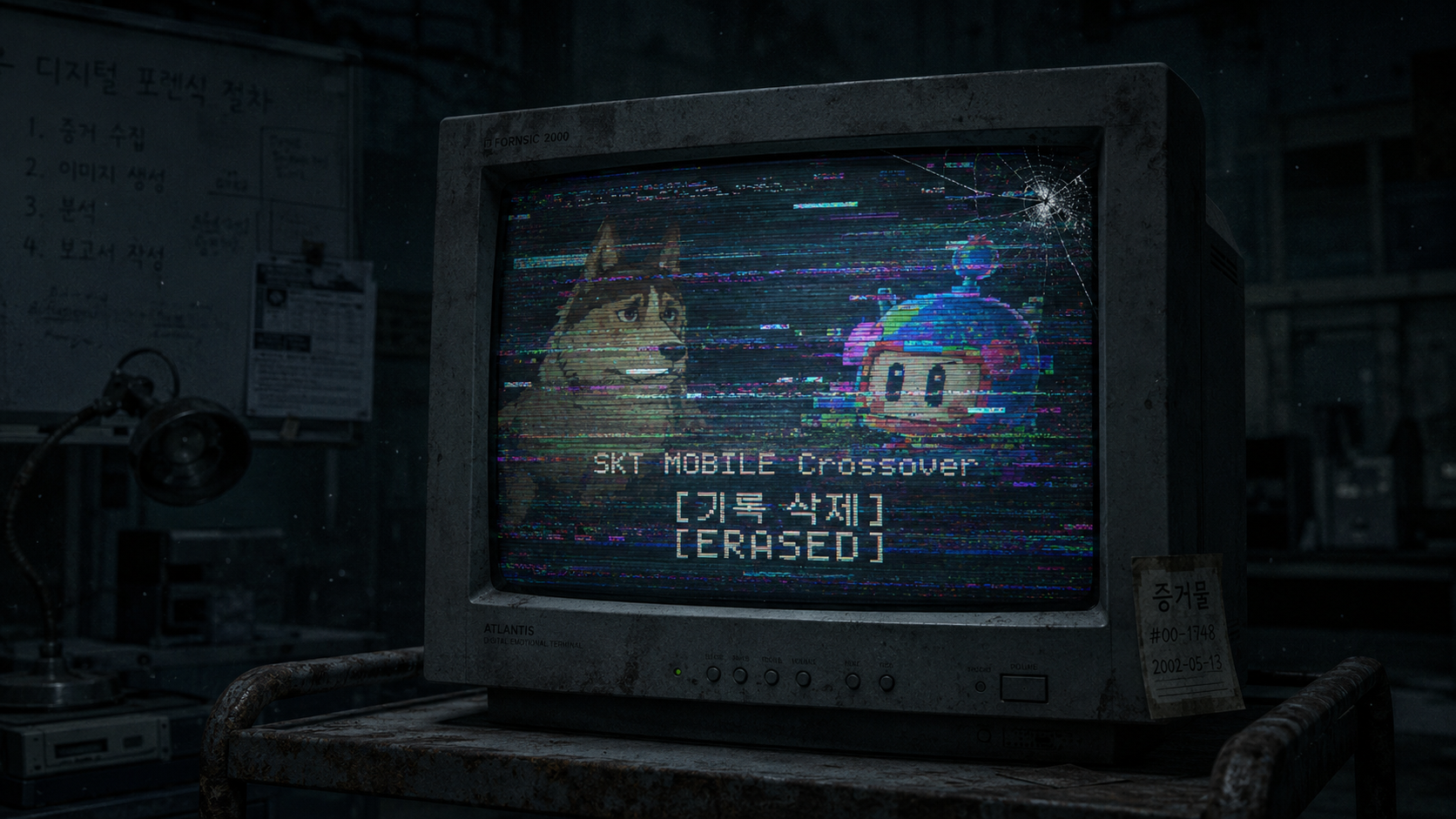
There is a particular species of unease that arrives not from encountering something strange, but from discovering that something strange once existed and has since vanished without ceremony. It is the unease of the empty vitrine in the museum—not frightening in itself, but deeply, structurally wrong. The case of SK Telecom’s early 2000s mobile crossover commercial operates precisely on this frequency. It is not a horror story. It is something quieter and more clinical: evidence of a culture that metabolized its own media faster than it could preserve it, leaving behind only the faint chemical traces that forensic work, years later, struggles to read.
The commercial—estimated to have aired somewhere between 2000 and 2003, definitively prior to 2004—promoted four properties simultaneously under the SKT mobile service banner: Star Mania, A Dog of Flanders, Subway Line 2, and Crazy Arcade BnB (known in Western markets as Bomberman). The video itself is gone. What survives is the textual residue: lyric transcripts buried in legacy forums for the MMORPG Stone Age, unearthed through targeted net-archeology in 2017. The corpse has been identified by its dental records alone.
The Cultural Anatomy: A Market That Moved Before Its Infrastructure Could Follow
To understand what produced this commercial, one must first understand the specific economic climate of late 1990s and early 2000s South Korea—a market operating at a tempo the rest of the world would not reach for nearly a decade.
While Western consumers in 2002 associated mobile technology with the Nokia N-Gage’s awkward form factor and primitive text-based diversions, South Korea already possessed a mature, corporate-monopolized mobile internet infrastructure. SKT—SK Telecom—was not a scrappy startup evangelizing smartphone futures. It was a dominant telecommunications conglomerate operating a sophisticated mobile content ecosystem; one capable of delivering licensed multimedia, branded games, and streaming audio to handset subscribers years before the concept became globally legible. This is not merely a quirk of Korean technological development. It represents a fundamental temporal dissonance: a society that digitized so completely, so rapidly, that the infrastructure supporting its cultural production became obsolete and was liquidated before anyone thought to archive what ran on it.
The censorship context here is not governmental. It is market censorship—the subtler, more absolute variety. When a premium mobile tier is shuttered for failing to meet revenue targets, the cultural artifacts it hosted do not get transferred to a public archive. They do not receive a deprecation notice. They are simply excised, cleanly and permanently, because no commercial incentive exists for their preservation. The Korean telecommunications market of the early 2000s was not hostile to culture; it was indifferent to it, in the specific way that only high-velocity capitalist infrastructure can be indifferent—not through malice but through the structural inability to assign value to things that no longer generate returns.
Structural Dissection: The Anomalies in the Signal
The four properties assembled in the commercial are worth examining individually before confronting the fact of their coexistence.
A Dog of Flanders is a 19th-century Belgian novel by the English author Marie Louise de la Ramée, adapted into a Japanese animated series in 1975 that achieved extraordinary cultural penetration in South Korea and Japan—far exceeding its reception in the Western European countries whose pastoral landscape it depicts. The story follows Nello, a Flemish peasant boy, and his dog Patrasche; it ends in the characters’ deaths by exposure in a church, reunited with a painting by Rubens. It is, by any measure, a tragedy. A formally structured, aesthetically serious literary tragedy.
Subway Line 2 is a transit simulation game. Crazy Arcade BnB is a chaotic, candy-colored multiplayer bomber game predicated on cartoonish violence and rapid sensory stimulation. Star Mania is a mobile rhythm title.
The pairing is not merely incongruous. It is surreal in the precise clinical sense—it violates the associative logic by which branded properties are normally combined. In Western markets, licensed properties are managed through layers of corporate legalism; the estate of a 19th-century novelist’s work sits in a separate category from an arcade game’s intellectual property, and the idea of folding them into a single marketing vessel would encounter legal, aesthetic, and brand-safety objections at every stage of production. The resulting commercial would simply never be approved.
That it was approved—that it was produced, aired, and presumably performed adequately enough to run its broadcast cycle—tells us something precise about the South Korean media market of the period. Licensing in this context was not a sacred trust between art and commerce; it was a transactional arrangement between content holders and a telecommunications provider seeking to demonstrate the breadth of its mobile library. The tragedy of Nello and Patrasche and the frenetic joy of BnB occupied adjacent cells in a content catalogue. The commercial’s rapid-fire format—lyric transcripts suggest a pace closer to advertising jingle than considered promotional material—was the logical product of a platform trying to demonstrate quantity and variety simultaneously.
What registers as surreal to the Western observer registered, in that market at that moment, as efficient. This is the first anomaly worth marking: the cultural uncanniness is not intrinsic to the material. It is a product of the observer’s position.
The second anomaly is temporal. The commercial exists in a zone of technological advancement that Western periodization cannot easily accommodate. It predates the iPhone by half a decade; it predates widespread Western mobile internet adoption by longer still. Yet it was a sophisticated piece of branded multimedia content for a mobile platform. It belongs, chronologically and technologically, to a category that Western media history has not constructed—the advanced mobile dark age—because the West did not experience an advanced mobile dark age. Korea did. And the artifacts of that age decayed on vectors that Western preservation frameworks were not designed to track.
Psychological Necropsy: Why This Silence Disturbs
The Western encounter with lost Korean media of this period produces a specific cognitive dissonance that is worth anatomizing carefully, because it is instructive rather than merely atmospheric.
Lost media has a well-developed amateur archaeology in Western internet culture—Doctor Who episodes, early television broadcasts, pre-code films. These artifacts are understood as lost through comprehensible mechanisms: fire, flood, magnetic degradation, the pre-video economics of broadcast television. The loss is unfortunate; the mechanisms are legible. Preservation projects exist; institutions sometimes hold fragments.
The SKT commercial refuses this framework. It was not lost through neglect or disaster. It was produced on a platform that was subsequently liquidated; its textual residue survived only because fans transcribed lyrics to a forum for an unrelated game. The video record—the actual broadcast artifact—has no known surviving copy. Not because the tape decayed, but because the infrastructure that might have preserved it was written off as a line item.
This is the mechanism that disturbs: not physical decay but social erasure. The commercial existed within a walled commercial ecosystem; when that ecosystem’s economic rationale evaporated, the media it contained was not dispersed or degraded—it was structured out of existence. The distinction is significant. Physical decay implies that the artifact existed, circulated, left traces, and then gradually became inaccessible. Social erasure implies that the artifact existed within a system that assumed no obligation of continuity, and when the system ended, the artifact ended with it—cleanly, completely, with no residue beyond what had already escaped the system’s boundaries.
What escaped, in this case, was a set of lyric transcripts posted to a Stone Age forum by someone who had memorized the jingle. The margins of the archive survived because a human being, for reasons personal and incidental, committed the text to an external system. The broadcast itself—the actual signal—is gone.
The Evidence of Void: Physical Decay vs. Social Erasure
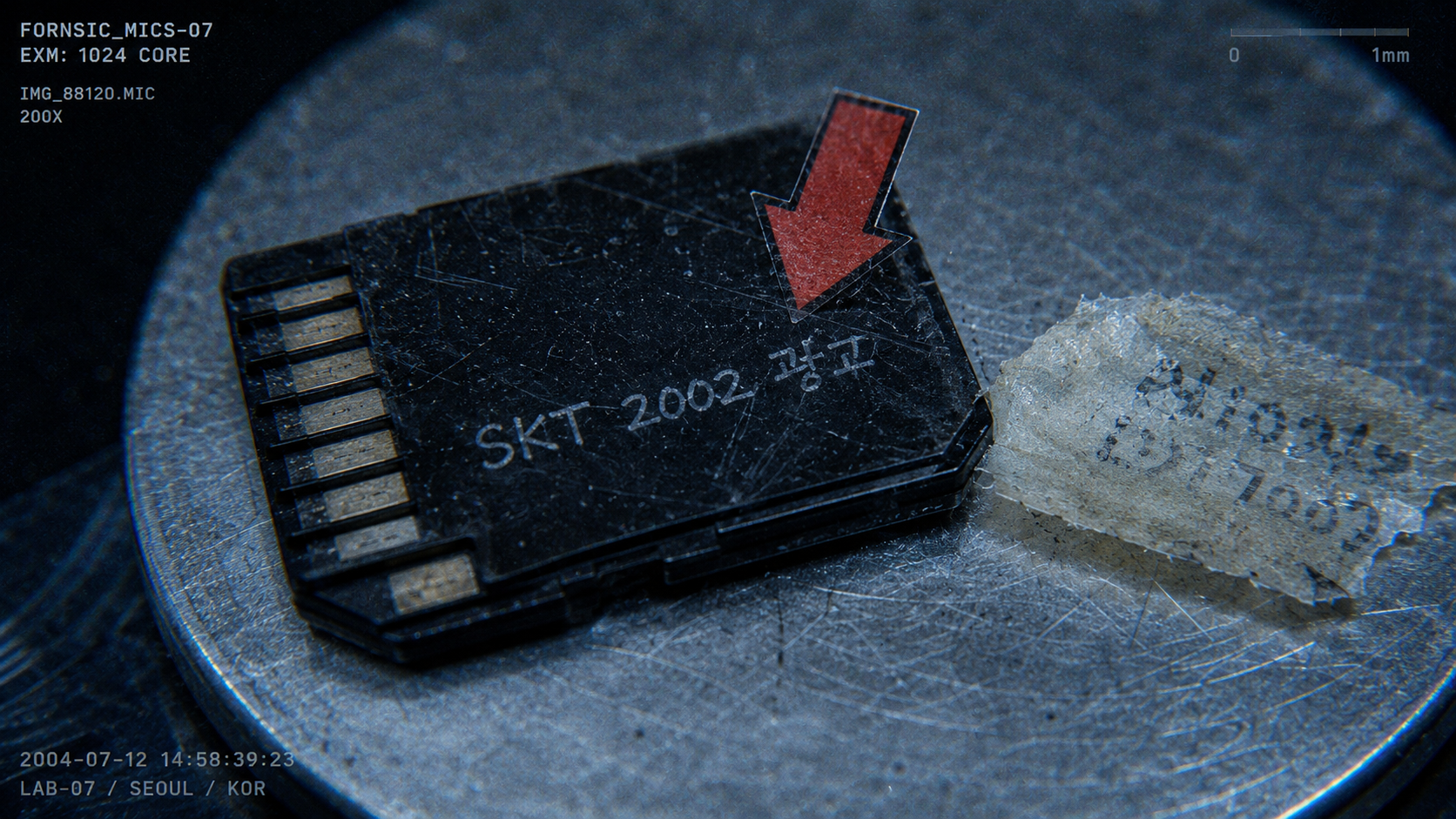
Concurrent with the commercial, investigators uncovered a second artifact—or rather, the ghost of one. Between 1999 and 2000, an official multimedia project was developed under the SKT premium service umbrella: a gritty detective and procedural property, existing in some state between game concept, narrative project, and branded entertainment. Four pages of concept art were shown to Premium Members in 2003. Shortly thereafter, the premium service tier was shuttered. The concept art was scrubbed. The project, whatever it was, ceased to exist in any publicly accessible form.
This second case is more extreme than the commercial because it involves not just the loss of a broadcast artifact but the erasure of an unreleased creative work at the precise moment of its limited disclosure. The project was, briefly, real—acknowledged, previewed, assigned to a subscriber tier. Then it was not. The abruptness is total; there is no degradation curve, no partial preservation, no fragment that escaped. Only the knowledge that the concept art existed, and that four pages of it were shown to a defined population of subscribers who presumably lack the documentation to prove it.
The distinction between physical and social loss matters enormously here. A nitrate film that burns in a warehouse fire represents a failure of material preservation—regrettable, comprehensible, addressable through better archival practice. A corporate multimedia project scrubbed from a premium platform at the moment of service cancellation represents a failure of a different order: the logical conclusion of a system in which cultural production is treated as a service-delivery asset rather than as a thing with intrinsic archival value.
Physical decay is entropy. Social erasure is policy. One can, in principle, be fought with better infrastructure; the other requires a fundamentally different conception of what digital media production obliges its creators and platforms to preserve.
The 2017 discovery of the lyric transcripts—the moment when targeted net-archeology produced documentary evidence that the commercial had actually existed and was not collective false memory—represents a rare instance of the former system partially overcoming the latter. The lyrics survived not because any institution preserved them, but because the chaotic, non-institutionalized nature of early MMORPG forum culture produced a kind of accidental archiving; fans posted trivia to platforms that lacked the revenue model to justify systematic deletion.
The irony is precise: the premium, corporate-managed tier erased the detective project. The free, community-managed forum preserved the jingle.
The Point of No Return: Digital Memory and the Corporate Chimera
The forensic metaphor that organizes this analysis—treating the media as a cadaver—is not merely rhetorical. It reflects a real epistemological condition. We cannot interview the subject. We cannot retrieve the full record. We can only examine what remains and draw conclusions about the mechanism of death.
The mechanism, in this case, was corporate indifference operating at speed. SK Telecom was not malicious; it was not engaged in censorship in any politically meaningful sense. It was a telecommunications company managing a content portfolio in a high-velocity market, making the rational economic decision to liquidate assets that no longer generated returns. The detective project was a sunk cost. The premium tier was a failed experiment. The commercial was a legacy campaign for a deprecated product cycle.
None of these are decisions that anyone made while thinking about cultural preservation. That is precisely the point.
The SKT case represents something that becomes increasingly common as digital infrastructure matures and is periodically liquidated: the production of what might be called the corporate chimera—media that exists at the intersection of multiple intellectual properties, platforms, and commercial ecosystems, whose survival depends entirely on the continued operation of the systems that produced it. When those systems are decommissioned, the chimera does not merely become unavailable. It becomes, in the absence of external archiving, ontologically uncertain—a thing that may or may not have existed, verifiable only through the accidental traces left by individuals who experienced it.
The lyric transcripts on the Stone Age forum are not a satisfying archival record. They are a scar. They confirm that the body existed; they tell us almost nothing about the body itself. The broadcast video, the full commercial in motion, the sound design, the specific juxtaposition of Nello’s tragedy and BnB’s chaos in moving image—all of that is gone. The detective project’s concept art—the visual language of a gritty procedural Korea almost produced at the turn of the millennium—is gone more completely still.
What this case demonstrates, finally, is that the digital era’s relationship to its own past is not more stable than the analog era’s; it is differently unstable. This transition from presence to absence is not gradual. It is instantaneous—a server decommissioned, a database deleted, a premium tier cancelled. There is no in-between state, no partially burned negative, no faded print that scholars can work to restore.
The SKT commercial and its companion detective project did not fade. They were switched off.
What remains is a fever dream with documented lyrics; a tragedy and a bomber game and a subway simulator briefly sharing a single mobile vessel; four pages of concept art shown once to a closed subscriber group and never again; and the persistent, uncomfortable knowledge that the digital archive has no structural obligation to remember what it once contained.
🔍Search Update: Call to Action
The 3AM Archive is initiating a call for action within the global Lost Media community. We are seeking any archival remnants from South Korean satellite or cable broadcasts between 2000 and 2004, specifically segments containing commercial breaks or SK Telecom promotional blocks. While the “social erasure” was severe, the randomized nature of early analog recordings offers a marginal probability of capture. If you possess VHS recordings, legacy hard drives, or access to pre-2004 East Asian intranet mirrors, contact the Archive immediately. We do not excavate the silence because we expect to find the body intact, but because understanding the mechanism of its disappearance tells us something precise and useful about the infrastructure that will, eventually, erase us all.
This document is an investigative archival reconstruction based on fragmented public records, media remnants, community accounts, and verified historical sources compiled by The 3AM Archive.
The article examines how incidents, forgotten media, internet folklore, and unresolved public memories evolve through cultural preservation and digital decay.
This is a cultural investigation document — not fictional horror content.
All visual materials used in this post are exclusive AI-generated assets created for The 3AM Archive.
