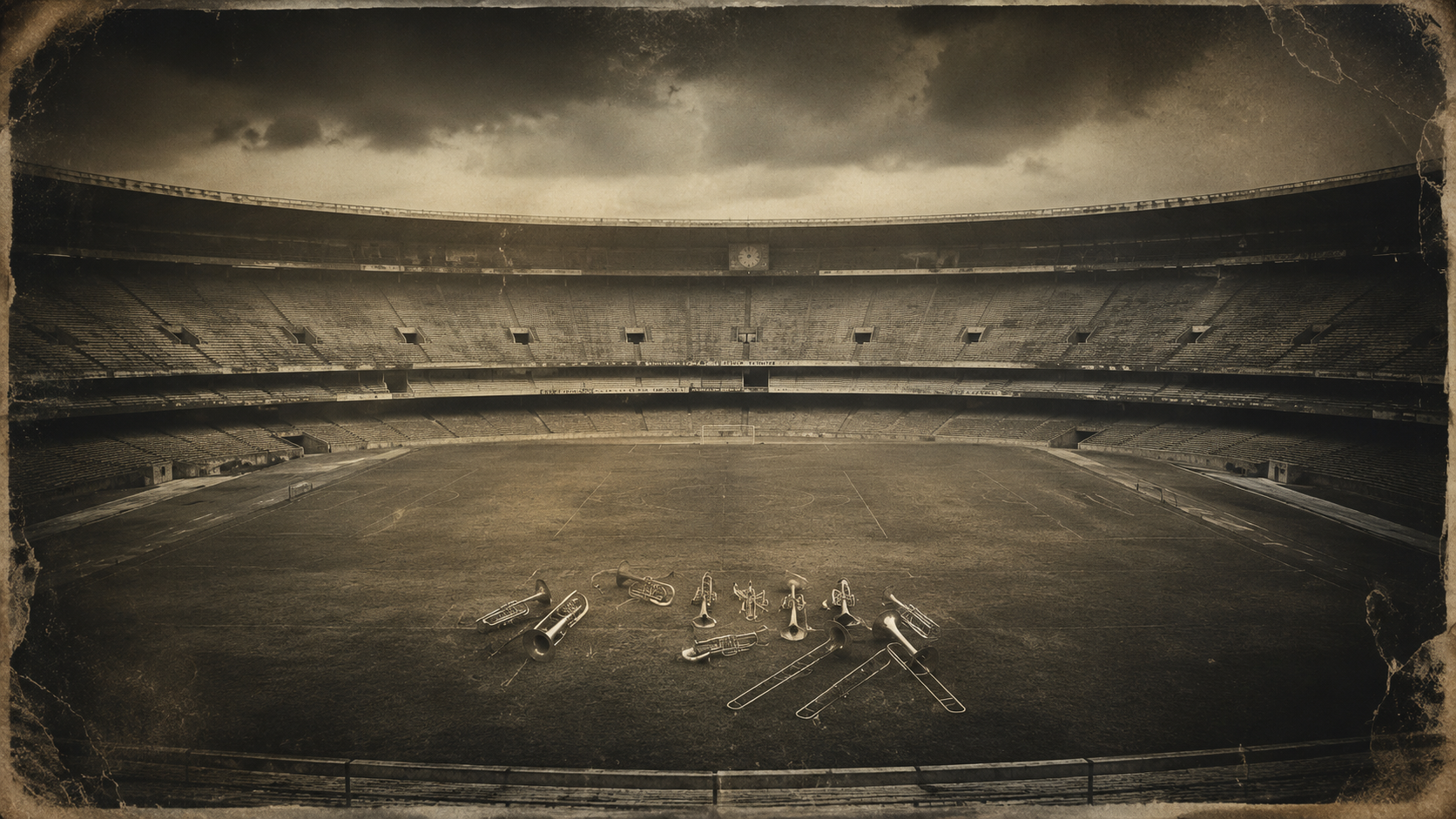
There is a specific kind of dread that has no common name in English—the sensation of entering a room where something catastrophic has just finished happening. The air is wrong. The furniture is wrong. The silence carries a specific pressure that ordinary quiet does not. Psychologists sometimes call it the “post-event horizon,” that membrane between a reality that existed and the reality that replaced it without warning. Cultural artifacts can embody this membrane. Most of the time, they survive as curiosities. Occasionally, they are destroyed so thoroughly, so reflexively, that their destruction becomes the artifact.
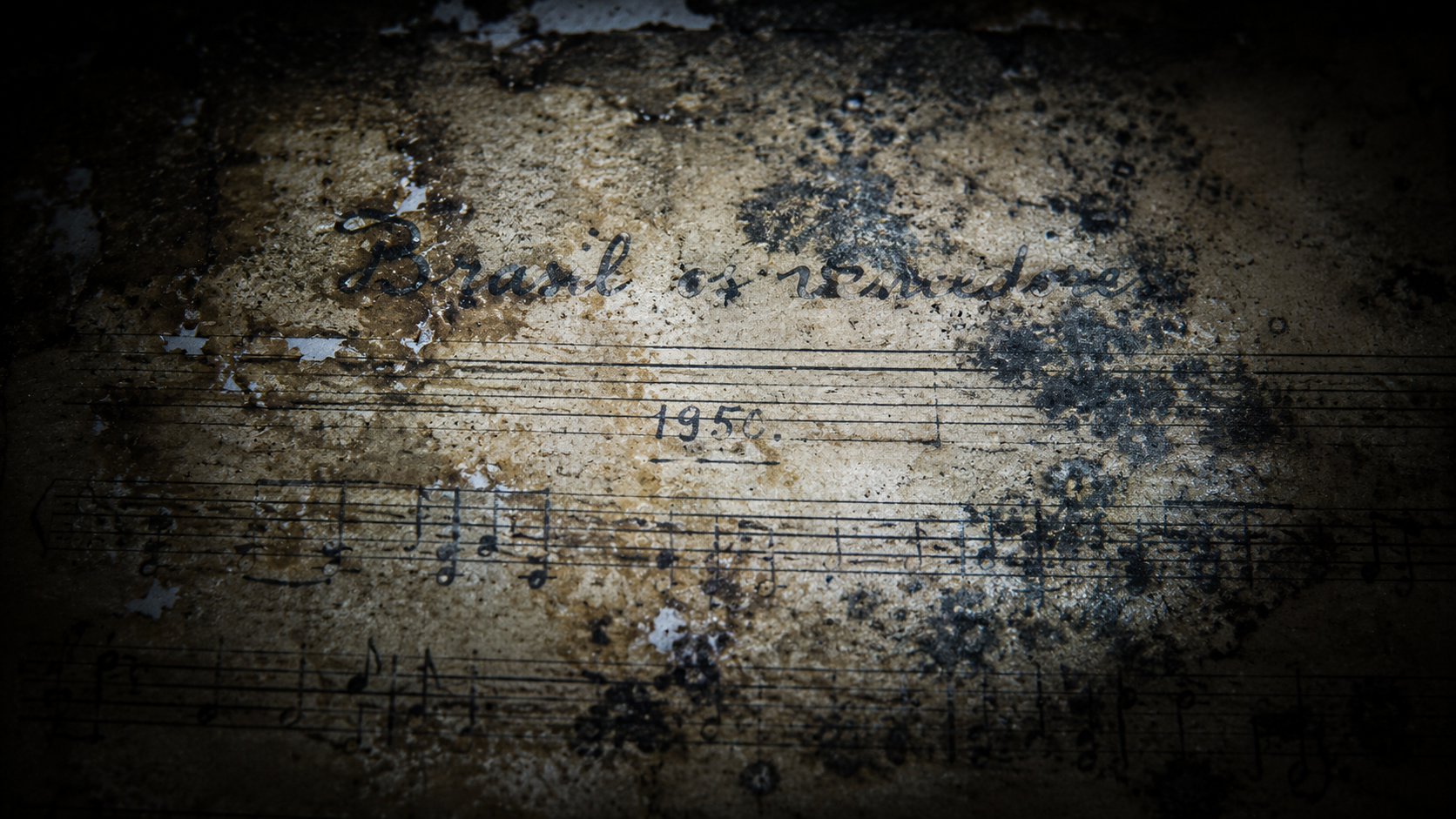
“Brasil os vencedores”—Brazil the Victors—is that second kind of thing. It is not a piece of lost media in the conventional sense. It is a sonic monument to a timeline that was murdered before it could begin.
The Cultural Anatomy: A Nation That Rehearsed Its Own Coronation
To understand what was lost on July 16, 1950, one must first understand what Brazil believed it was walking into.
The 1950 FIFA World Cup was held on Brazilian soil, under a Brazilian sky, in a stadium—the Maracanã—that was itself an act of architectural propaganda. Completed just weeks before the tournament began, the Estádio do Maracanã was built to house 200,000 people. That number was not accidental; it was a signal. Brazil was not merely hosting a football tournament. It was staging a national consecration.
The political context encoded in this hubris matters. Brazil in 1950 was a country still negotiating its identity after the Vargas era—a period of authoritarian nationalism that had, among other ambitions, attempted to construct a coherent Brazilian national mythology through sport, industry, and cultural production. Football was not separate from this project; it was central to it. A World Cup victory on home soil would not have been merely athletic. It would have been a geopolitical statement, a confirmation that Brazil had arrived as a modern nation-state.
This is why the behavior of Rio de Janeiro’s civic apparatus in the hours before the final match was not hysteria. It was institutional certainty. Mayor Ângelo Mendes de Moraes delivered a speech to the players—the players, before they had played—in which he declared them victors. Not future victors. Victors. Early print runs of major newspapers went to press announcing the championship. The language of contingency was simply absent from official discourse. The match against Uruguay was, in the minds of those running the city, a formality wearing the costume of a football game.
Into this context, a brass band rehearsed “Brasil os vencedores” inside the Maracanã on the morning of July 16. They ran through it fully—every bar, every dynamic swell. The plan was simple and completely unambiguous: the moment the final whistle confirmed what everyone already knew, the anthem would play. Two hundred thousand people would hear it simultaneously. The sound would travel out of the stadium and into the streets of Rio, where it would confirm, in musical terms, what the morning papers had already announced in print.
The band was rehearsing the soundtrack to a reality that had not yet been authorized by events. That distinction did not seem to concern anyone.
Structural Dissection: Anomalies in the Signal
Uruguay won 2-1. Alcides Ghiggia scored the decisive goal in the seventy-ninth minute.
What happened next is the anomaly that demands forensic attention.
Two hundred thousand people did not riot. They did not fight. They did not, in any meaningful collective sense, react at all. Eyewitness accounts—journalists, players, stadium workers—converge on a single, dissonant description: silence. Not the silence of a crowd that has gone quiet; the silence of a crowd that has been switched off. Jules Rimet, who presented the trophy to Uruguay’s captain Obdulio Varela in what one account describes as a furtive, almost fugitive ceremony, reportedly did so without ceremony, without speech, without the formal architecture that victory celebrations are supposed to require. The infrastructure of triumph—the speeches, the processions, the anthem—simply did not execute. The absence was total.
This is the structural anomaly. When a system is designed to produce an output and the input conditions change at the last second, systems typically fail loudly. They produce error states, partial outputs, corrupted data. What happened at the Maracanã was the opposite: a clean, immediate, catastrophic non-execution. The anthem did not play. The newspapers were pulled from circulation or became, overnight, collector’s items of accidental irony. The sheet music and any recordings of “Brasil os vencedores” were suppressed, discarded, or destroyed through a process that was not organized—there was no government ministry ordering the purge—but was instead emergent. Organic. Reflexive, in the way that a hand jerks back from fire before the brain has consciously registered the heat.
The signal that “Brasil os vencedores” was supposed to carry—victory, national greatness, the confirmation of a manufactured destiny—was not just undelivered. It was retroactively refused. The infrastructure that would have broadcast it, the human beings who had memorized it, the institutions that had commissioned it: all of them, simultaneously, elected to behave as though the piece had never existed. Not through coordination. Through shame.
That is not how media typically becomes lost. Media becomes lost through neglect, through entropy, through institutional disorganization. This piece was not neglected. It was actively uninhabited—left to die by the unanimous, unspoken agreement of everyone who knew it existed.
Psychological Necropsy: Why This Silence Disturbs the Western Mind
There are two distinct cultural frameworks through which “Brasil os vencedores” is currently processed, and they illuminate different aspects of what makes it strange.
In East Asian digital cultures—particularly on platforms like NamuWiki—the story is categorized under what Korean internet culture calls 설레발 (seol-re-bal): the fatal curse of premature celebration. This is a concept with deep folkloric roots; the idea that announcing victory before it is secured invites cosmic punishment. Within this framework, the story of the 1950 anthem is darkly comic, even morally instructive. Hubris was punished. The universe corrected an imbalance. There is something almost satisfying about the narrative symmetry—the anthem rehearsed but never played functions as a perfect emblem of arrogance receiving its invoice.
Western lost-media communities read the same artifact through an entirely different register. On platforms like Reddit’s r/LostMedia and in the broader analog horror discourse, the resonance is existential rather than karmic. The horror, in this reading, is not that Brazil was punished for hubris. The horror is that a fully formed piece of media—written, orchestrated, rehearsed, performed to an empty stadium on the morning of its intended debut—simply ceased to exist as a social fact. Not through destruction, exactly; through unanimous refusal.
This maps onto a specific subgenre of liminal anxiety that has emerged in Western internet culture over the past decade: the horror of the EAS broadcast, the Backrooms, the emergency signal with no sender. These are all scenarios in which the infrastructure of communication activates, but the context that would give it meaning is absent or wrong. “Brasil os vencedores” is, in this reading, an EAS alert that was composed, tested, and loaded—and then the event it was designed to announce was replaced by its opposite. The broadcast infrastructure sat there, fully operational, pointing at a reality that had evaporated. And then, rather than produce an error state, it simply fell silent.
Two hundred thousand people in the Maracanã knew exactly what that silence meant. They were the ones who had been meant to sing along.
The Evidence of Void: Why It Remained Lost
Lost media scholars typically deal with two categories of absence: physical decay and social erasure. Most lost media is lost through the former—nitrate film dissolving, magnetic tape degrading, master recordings destroyed in fires. The loss is entropic, impersonal, accidental. Nobody chose for the film to dissolve; time chose for them.
“Brasil os vencedores” belongs to the second category, and this is rarer and more disturbing. The sheet music did not decay. Any recordings made during the morning rehearsal did not spontaneously demagnetize. The brass band members did not collectively suffer amnesia. The piece was actively unmemorialized—not destroyed in any single dramatic event, but simply never spoken of, never archived, never cited, never sung again. In a country where football mythology is among the most elaborately maintained in the world, this particular artifact found no custodian. No collector. No archivist. No nostalgic veteran musician who kept a copy in a drawer somewhere.
This suggests that the suppression operated not through institutional command but through something closer to a cultural immune response. The Brazilian collective memory treated “Brasil os vencedores” the way a body treats a pathogen: not by studying it, but by eliminating it before it could establish itself. The grief of O Maracanaço was so acute—so structurally incompatible with the national self-image that had been constructed around that match—that anything which encoded the pre-defeat certainty became, by contagion, unbearable. The newspapers were not burned; they were simply not saved. The sheet music was not confiscated; it was simply not filed. The recordings were not erased; they were simply not preserved.
Physical decay destroys media. Social erasure does something more thorough: it removes the impulse to prevent the decay.
The Point of No Return: What the Void Remembers
There is an uncomfortable conclusion that a forensic examination of “Brasil os vencedores” forces into view—one that extends well beyond a football match or even a national trauma.
Digital culture has generated, over the past two decades, an enormous apparatus for the recovery of lost media. Dedicated communities scour archives; algorithms index obscure materials; crowdsourced memory projects attempt to reconstruct what physical entropy destroyed. The implicit assumption underlying all of this activity is that loss is an accident—that media exists, and then circumstances intervene to make it inaccessible. The proper response, in this framework, is recovery: finding the thing that circumstance misplaced.
“Brasil os vencedores” does not fit this framework, because it was not lost by accident. It was refused. And there is no recovery protocol for a piece of media that an entire national culture decided, in real time, to decline to remember. The archival silence is not a gap in the record; it is the record. The void is the document.
This is the point at which the anthem becomes something more philosophically disturbing than a football curiosity. It raises the question of what digital preservation—with its implicit faith in the recoverability of everything—actually preserves. It preserves what someone, somewhere, chose to keep. It preserves objects that survived the filter of human decision-making about what deserves to exist. “Brasil os vencedores” did not survive that filter; it was fed through it deliberately, by an entire nation, in a single afternoon.
The band rehearsed the anthem on the morning of July 16, 1950. By the evening of July 16, 1950, the decision had been made—not by any individual, not through any formal process—that the anthem had never been rehearsed. That the piece had never been written. That the future it was written for had never been seriously anticipated.
What remains is not the anthem. What remains is the shape of the silence where the anthem was supposed to be—an acoustic ghost, a compression in the cultural record where something should protrude but does not. The Maracanã’s roar on the morning of July 16 was the last time anyone ever performed “Brasil os vencedores.” By nightfall, it had become what it remains today: a piece of music that exists only as the fact of its own absence.
Some voids are louder than what they replaced. This is one of them.
🔍Search Update: Call to Action
The 3AM Archive is initiating a forensic trace on the sheet music, local radio tape logs, or municipal brass band rosters from Rio de Janeiro dated between June and July 1950. If you have access to uncataloged Brazilian broadcast storage, estate records of mid-century musicians, or discarded early print editions of regional newspapers from July 16, 1950, contact our investigative desk. The default archive of human experience shouldn’t have gaps this absolute. Help us determine if the physical data still breathes beneath the silence, or if the erasure was truly total.
This document is an investigative archival reconstruction based on fragmented public records, media remnants, community accounts, and verified historical sources compiled by The 3AM Archive.
The article examines how incidents, forgotten media, internet folklore, and unresolved public memories evolve through cultural preservation and digital decay.
This is a cultural investigation document — not fictional horror content.
All visual materials used in this post are exclusive AI-generated assets created for The 3AM Archive.
