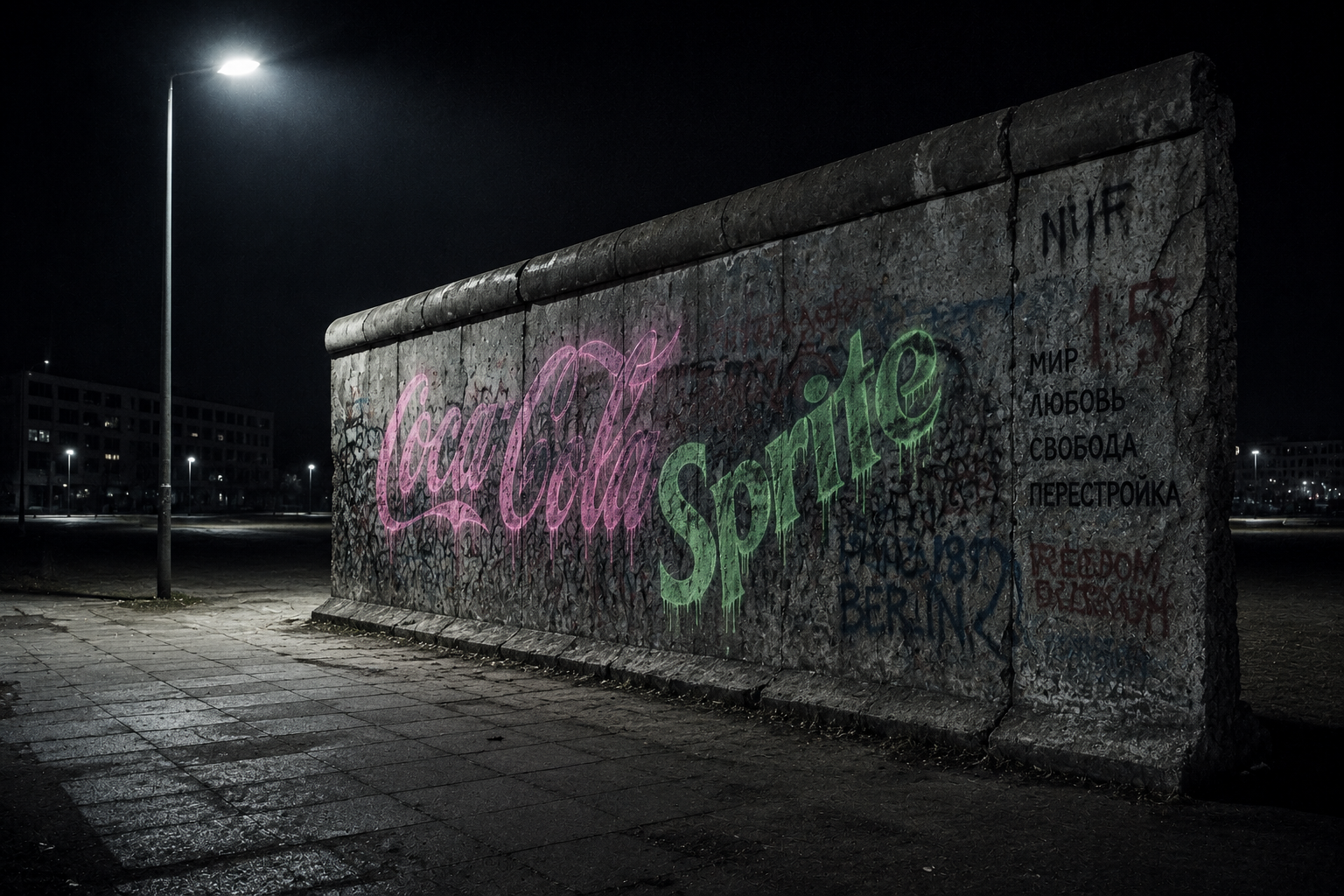
There is a particular category of cultural wound that resists easy diagnosis. Not the wound of censorship—governments have always been efficient there—nor the wound of neglect, which at least carries the dignity of indifference. The wound in question here is something more surgical: the erasure performed not by ideology, but by appetite. The subject is a 3.6-meter slab of concrete in Seoul’s Cheonggyecheon district. The instrument was fluorescent spray paint. The motive, exposed in the perpetrator’s own words, was commerce dressed as conscience.
What happened to Seoul’s gifted section of the Berlin Wall on June 8, 2018, is not a story about free expression. It is a clinical case study in what happens when a monument outlives the system that made it legible—and what happens when a man with a clothing brand and a smartphone mistakes the corpse of history for a billboard.
The Cultural Anatomy: A Scar Transplanted
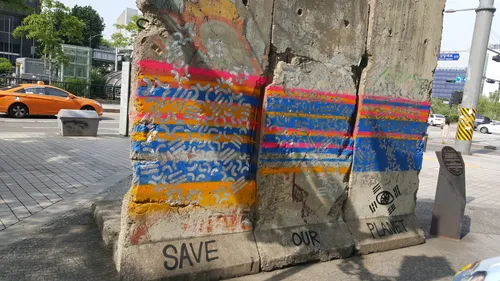
The Federal Republic of Germany donated the artifact to Seoul in 2005. The choice was not incidental; it was structurally deliberate. Korea and Germany share a topology that almost no other nations do: the experience of national division drawn not along ancient ethnic lines but along the fault lines of twentieth-century ideology. The gift acknowledged this. Installed near Cheonggyecheon Stream at a plaza formally designated “Berlin Square,” the segment of Wall was meant to function as a talisman—a physical argument that what was sundered could be rejoined.
The object had two faces, and this distinction is the entire crux of the incident.
The western face carried authentic Cold War-era graffiti. Not the sanitized, retrospectively meaningful murals of the East Side Gallery—those were painted after reunification, by invited artists, as a kind of commemorative performance. This was something rawer: the accumulated sediment of ordinary West Berliners expressing themselves against a concrete border they could touch but not cross. Messages, names, political slogans, abstract marks—the kind of writing that emerges when a wall is both a wound and the only surface available. This face had been produced under the genuine pressure of division; it bore that pressure in its texture.
The eastern face was blank. Completely, deliberately, structurally blank.
That blankness was not absence. It was information—perhaps the most concentrated historical information on the entire artifact. Under the German Democratic Republic, the eastern side of the Wall was part of the Todesstreifen, the death strip. No civilian could approach it without risk of being shot. The East German state did not permit graffiti; it permitted the absence of graffiti, which it enforced with tripwires, searchlights, and armed guards. The pristine concrete on the eastern face was a perfect, preserved negative impression of a totalitarian information landscape. It was, in a meaningful sense, the most honest document the Stasi ever produced—because it was produced by their silence rather than their propaganda.
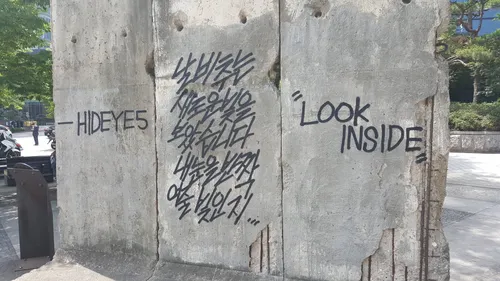
This is the artifact that Taeyong Jeong, known by the alias HIDEYES and also as Terry Jung, encountered in the early hours of June 8, 2018.
Structural Dissection: The Anomaly in the Signal
What Jeong did to the wall was thorough. He painted both faces—west and east alike—with fluorescent patterns, his brand’s name, and a stylized Korean flag rendered in commercial-grade spray paint and oil markers. The act was not a hasty tag. It was a sustained, deliberate overpainting that required time and preparation. He did not treat the western face differently from the eastern. The distinction that had taken thirty years and the physical apparatus of a state to produce was ironed flat in a single night.
His after-the-fact framing cycled through several registers. He invoked Banksy. He referenced the April 2018 inter-Korean summit at Panmunjom—as though painting his brand name over Cold War concrete were a plausible act of peninsular solidarity. He claimed the mantle of international human rights expression, a framing that attracted support from PEN America and other Western free-speech organizations who processed the incident through a framework of artistic transgression against state power.
The framework was wrong. It was wrong because it misidentified the power structure in the room.
Artistic transgression requires a system to push against. Banksy’s work carries its charge precisely because it materializes on the walls of functioning institutions—banks, immigration detention centers, apartheid barriers—where the system it critiques is still operational. The Berlin Wall section in Seoul was not a functioning instrument of division. It was a memorial. Pushing against it was not an act of defiance against totalitarianism; it was an act performed on totalitarianism’s corpse. The correct analogy is not Banksy painting on an active border. The correct analogy is someone spray-painting their brand logo on a headstone.
The private record was worse than the public performance. During the act, Jeong posted to social media: “Will my legs shake a bit during this graffiti crime? I don’t know what will happen, but let’s give this doodle a proper go. Screw it all.” The language is diagnostic. “Doodle.” “Screw it all.” This is not the idiom of political conscience; it is the idiom of viral content strategy. The calculation was not whether the act was historically defensible. The calculation was whether the footage would circulate.
It did. For reasons that have nothing to do with the reasons Jeong intended.
Psychological Necropsy: Why This Disturbs the Western Analytical Mind
The divergence in how this incident was received across cultural contexts is instructive and, on examination, somewhat damning of the Western interpretive framework that initially applied itself here.
In the United States and parts of Western Europe, the initial reflex was to locate the incident within the grammar of street art as political speech—a grammar developed largely to describe resistance to authority in contexts where authority is legible and present. PEN America’s intervention made sense within that grammar. Under that reading, a man painting a government-gifted monument was a dissident performing an act of symbolic refusal.
Korean public discourse, and the broader East Asian reception, operated from a different analytical premise. The object in question was not a government facility. It was a shared trauma made material. Painting over it was not resistance; it was an erasure of collective memory for private commercial gain. The Korean framing converged almost immediately on what the private social media posts later confirmed: this was clout-chasing, a term that has since achieved a kind of precise analytical utility. The act prioritized the generation of personal-brand visibility over the preservation of historical record; it treated the historical record as raw material for content.
The deeper disturbance—and this is where the psychological necropsy becomes genuinely uncomfortable—is what the incident reveals about the late-2010s influencer economy’s relationship to history. The logic of that economy is extractive and presentist: everything is content; all surfaces are canvases; the value of an object is proportional to its utility as a backdrop for self-documentation. Within that logic, a 3.6-meter section of the Berlin Wall is simply a very good backdrop. The historical charge it carries is, if anything, a feature rather than a bug—it adds gravity to the image without requiring any engagement with what that gravity means.
This is not cynicism unique to Jeong. It is a structural feature of platforms that reward attention regardless of its quality. The disturbing insight is not that one man was historically illiterate. It is that the entire information environment in which he operated had optimized specifically for historical illiteracy.
The Evidence of Void: Why Authenticity Cannot Be Restored
The Korean courts sentenced Jeong in 2019 to a 5 million KRW fine—approximately $5,000 USD. The court rejected his defense; PEN America’s backing notwithstanding, the legal determination was property damage, full stop.
The artifact remains in Seoul. It has not been removed. But what sits in Berlin Square now is a different object than what sat there before June 8, 2018—not because its physical mass has changed, but because the information it carried has been permanently overwritten.
This is where the incident departs from ordinary vandalism and enters the territory of what might be called irreversible archival loss. Standard vandalism damages surfaces; surfaces can, in many cases, be restored. Historical artifacts present a different problem. The Cold War-era graffiti on the western face was not art that could be recreated from documentation. It was the unmediated physical residue of specific individuals in a specific moment of historical pressure. No restoration effort can reconstitute that residue, because the residue was the thing—not an image of the thing, not a representation of it, but the actual physical traces left by the people who made them.
The eastern face’s blankness presents an even more intractable loss. A conservator can fill scratches in concrete. A conservator cannot restore the informational content of deliberate absence. The eastern side’s blankness communicated something because it was original blankness—concrete that had never been touched, preserved in that condition by the same coercive apparatus it testified against. Once painted over, once cleaned, once touched in any way, that testimony is permanently terminated. The wall can be repainted white. It will not be blank in the way it was blank before.
What is lost here is not recoverable through digital archiving, though photographs exist. Photographs of the wall’s pre-vandalism state document the surface; they do not preserve the surface. The distinction matters. This is a case of physical irreversibility compounded by social erasure—the artifact’s historical status degraded simultaneously in its material reality and in its cultural function.
The Point of No Return: Digital Memory and the Second Erasure
There is a final, uncomfortable observation to make.
The Stasi maintained one of the most comprehensive surveillance archives in human history. They documented everything—meetings, letters, phone calls, the movements of ordinary citizens across the GDR. What they could not document, by definition, was what didn’t happen within their surveillance perimeter. The eastern face of the Berlin Wall was part of what didn’t happen: no graffiti, no messages, no marks left by people expressing themselves freely, because the people who might have left those marks could not approach without being shot.
The eastern face was, therefore, an accidental counter-archive. It preserved the negative space of the Stasi’s own information economy. It was a document of what state terror looks like when it succeeds—not the tortured body, not the confiscated letter, but the blank wall at the edge of the death strip, unmarked because everyone knew better than to approach it.
Jeong’s paint erased both faces simultaneously. The western face—the record of free expression under pressure—and the eastern face—the record of its absolute suppression—were rendered equivalent. The fluorescent patterns that replaced them communicated, in their uniformity, precisely nothing about the Wall’s historical function. They communicated Jeong’s brand.
The second erasure is this: within the digital information environment that made Jeong’s act legible and circulable, the incident itself has become primarily a content artifact. It generates clicks. It generates outrage. It generates the kind of engagement that platforms reward. The wall’s historical function—as a physical argument for Korean reunification, as a preserved document of division’s texture—recedes behind the story of its own destruction.
What the Stasi spent thirty years producing by force—a landscape in which the voices of ordinary people leave no trace—Jeong achieved in one night, with fluorescent paint, by treating history as content. The irony is not incidental. It is the diagnosis.
The monument still stands. The history it was built to carry does not.
This document is an investigative archival reconstruction based on fragmented public records, media remnants, community accounts, and verified historical sources compiled by The 3AM Archive.
The article examines how incidents, forgotten media, internet folklore, and unresolved public memories evolve through cultural preservation and digital decay.
This is a cultural investigation document — not fictional horror content.
All visual materials used in this post are exclusive AI-generated assets created for The 3AM Archive.
