There is a particular category of archival silence that is more unsettling than destruction. When a building burns, the loss is at least legible—a before, a fire, an after. But when a piece of media simply ceases to exist without catastrophe, without witness, without even the dignity of a dated obituary, something more philosophically corrosive takes place. The record does not mourn it. The record does not acknowledge it ever breathed.
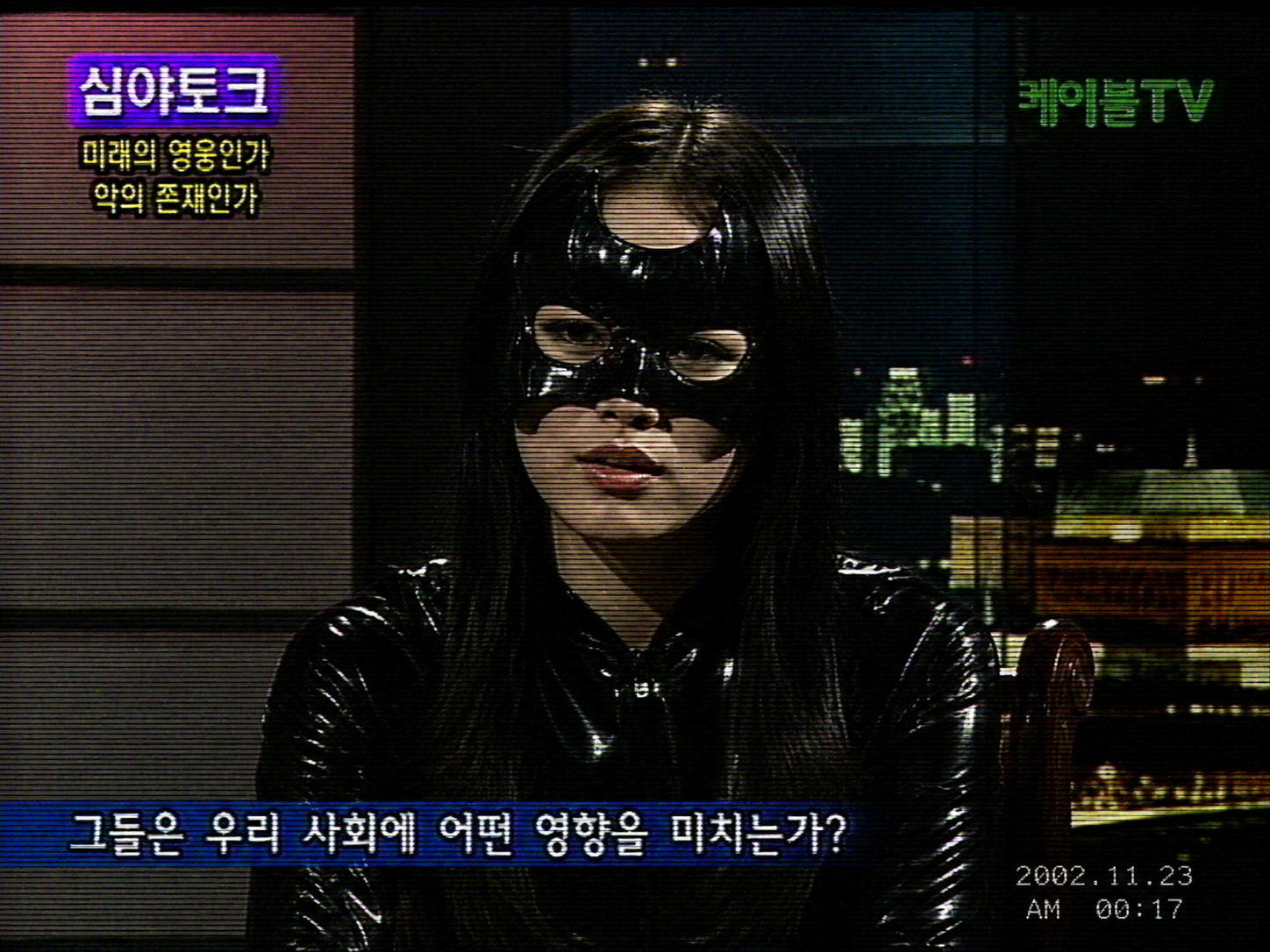
The 2007 CJ Media “Catwoman” fragment is one such object. It is not, technically speaking, a mystery in the narrative sense; no crime was committed, no conspiracy appears to be operating. What remains is a single compressed, low-resolution digital screen capture—a rectangular shard of evidence bearing one anonymous figure in a superhero costume inside what appears to be a South Korean cable broadcasting studio. That is the complete inheritance. No audio. No source footage. No production log. No name.
What the fragment describes, in clinical terms, is a woman who stood in front of a camera sometime around 2007 in Seoul. She existed. She was filmed. And then, with the quiet, bureaucratic efficiency unique to mid-tier cable broadcasting infrastructure, everything that could have identified her ceased to exist around her. What we are left with is not a ghost. It is something more sterile than that—a data point without a dataset.
The Cultural Anatomy: A Television System That Was Never Designed to Remember
To understand why this fragment exists in the condition it does, it is necessary to understand the specific media ecology that produced it. South Korean cable television in the mid-2000s was not a unified cultural archive. It was a deregulated commercial battleground.
Following the liberalization of the South Korean broadcasting market through the 1990s, cable networks multiplied with a speed that outpaced both regulatory frameworks and archival infrastructure. By 2007—the estimated temporal window for this footage—networks operating under the CJ Media umbrella, including XTM and Super Action, occupied a peculiar market position. They were legitimate, licensed broadcasters with access to professional production equipment; yet their late-night schedules operated in a legal and cultural grey area that operated under a temporary regulatory deficit distinct from contemporary Western compliance models.
Western cable systems of the same period were governed by FCC content regulations and maintained robust legal compliance departments. South Korean cable, particularly in its late-night interstitial content—the channel bumpers, transitional PSAs, and promotional vignettes—faced a considerably less structured environment. The incentive was simple: capture adult viewership in the hours after midnight by producing content that was hyper-stylized, sexually suggestive, and tonally uncanny. These were not prestige productions. They were functional objects designed to hold attention for thirty to ninety seconds and then vanish.
The word “vanish” deserves attention here. These interstitials were never intended for archival consideration. No DVD release was planned. No broadcast rights package was negotiated. They were disposable visual furniture—closer in institutional status to in-store promotional footage than to television programming. Master tapes, if they were recorded to tape at all by 2007, would have been catalogued within a production house filing system that almost certainly no longer exists in its original form. Corporate restructuring, office relocations, and the transition to digital production workflows across Korean media in the late 2000s created conditions in which analogue tape archives were routinely destroyed, lost, or abandoned without documentation.
This is not a conspiracy. This is industrial housekeeping.
Structural Dissection: What the Fragment’s Anomalies Reveal
The surviving screen capture, low-resolution as it is, carries embedded information that allows for preliminary structural analysis—what forensic archivists might call a “signal autopsy.”
The costume itself—a recognizable Catwoman aesthetic, likely sourced from commercially available costuming rather than custom production—functions as an immediate and significant data point. To a Western observer conditioned by Warner Bros. IP culture, a “Catwoman” costume reads as corporate, mainstream, legally complex. This reading is almost certainly incorrect in the 2007 Seoul cable context.
By the mid-2000s, superhero costumes from American comic book franchises had achieved broad consumer market penetration across East Asia; they were available cheaply from countless manufacturers and required no special licensing for private or small-scale commercial use in a context where enforcement was minimal. For a low-budget interstitial producer, a Catwoman costume offered a specific set of functional advantages: it was visually striking, immediately legible to a broad audience, and—critically—it obscured the face. The mask was not a thematic choice. It was an operational one. It provided the anonymous actress, or the production itself, with a degree of plausible deniability that a standard presenter format would not.
This detail shifts the register of the footage significantly. We are not looking at fan media or a comic book tribute. We are looking at a production that leveraged low-cost anonymity to bypass talent licensing and talent tracking.
The hypotheses regarding the footage’s function diverge across four primary theories. It may have operated as a channel ID bumper for XTM or Super Action—a station identification clip designed to establish brand identity during late-night hours. It may have functioned as an anti-piracy PSA, a format popular across Asian broadcast networks in this period that frequently employed exaggerated, theatrical aesthetics to capture attention. It may have been a short-form adult comedy vignette, a format that proliferated in Korean late-night cable during the deregulation era. Or—the most geographically expansive hypothesis—it may represent a syndicated clip originating from a North American adult comedy production, redistributed into the Korean cable market through a now-untraceable distribution pipeline.
None of these hypotheses can currently be confirmed or eliminated. Each leaves the fragment in exactly the same epistemic position: present, evidenced, and structurally inexplicable.
Psychological Necropsy: Why This Particular Silence Disturbs the Western Mind
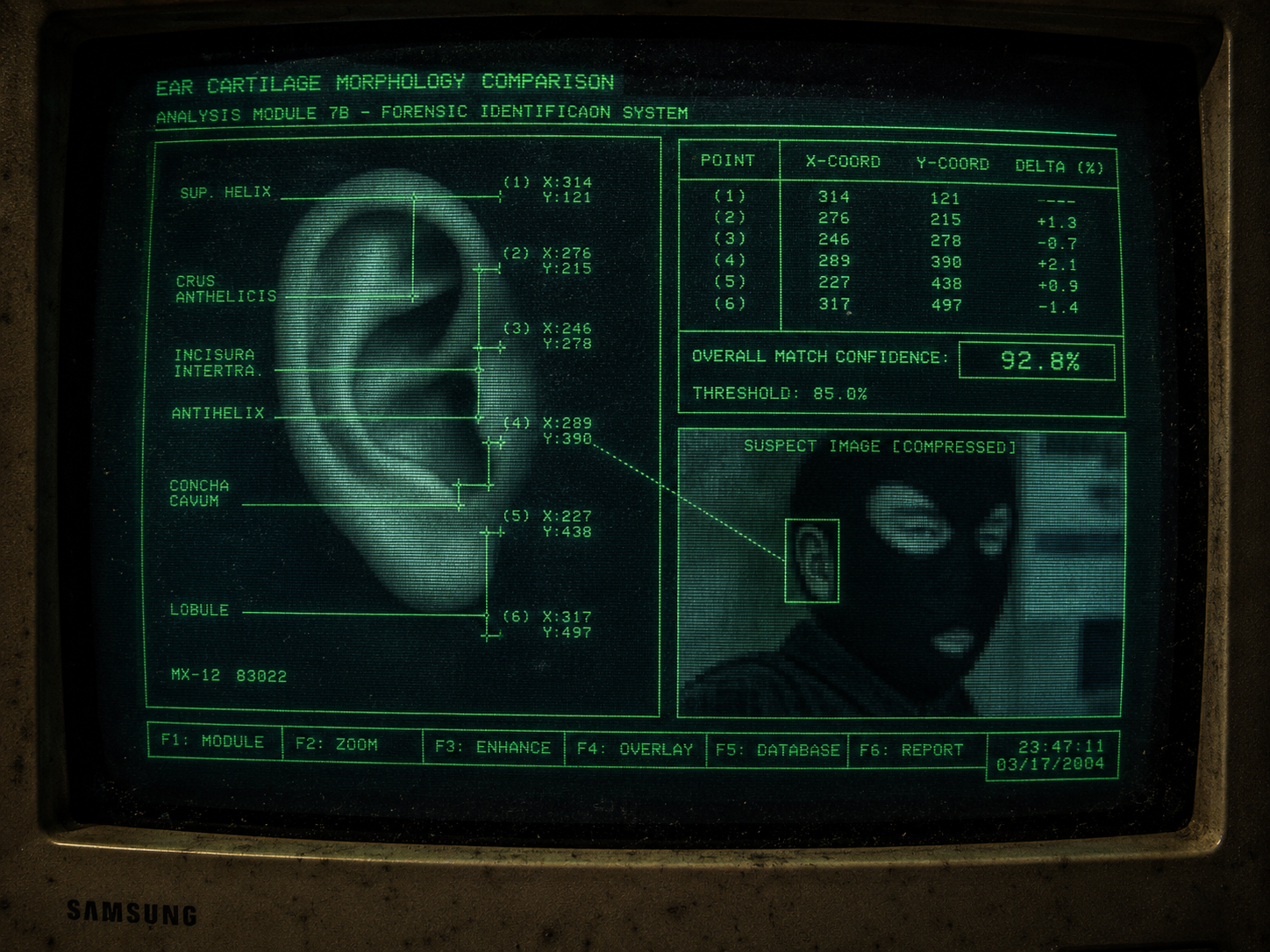
The forensic community’s attempt to identify the anonymous subject produced what may be the most intellectually significant detail in this entire case. A prominent domestic netizen theory proposed that the actress was South Korean model Jeon Shin-hae. The claim was not dismissed casually; it was subjected to genuine comparative analysis—auricular morphology, the precise geometry of ear cartilage, cross-referenced against thoracic proportion data visible through the costume. The conclusion was negative. The match was rejected.
Consider what this procedure represents. The human subject in the footage has been reduced, by necessity, to a collection of anatomical landmarks—data coordinates on a biological surface. Her face is masked. Her name is unknown. Her voice is unrecorded. The investigative community, operating in good faith with the best available methodology, had no choice but to treat her as a specimen rather than a person. And the specimen refused to be identified.
This is the dimension of the case that most directly exposes the structural limitations of Western open-source intelligence methods. Western digital archaeology is deeply, professionally familiar with loss—broadcast signs-off, erased videotapes, the missing Doctor Who episodes. But that tradition of loss operates within a framework of institutional documentation; there is almost always a production credit, a broadcast log, a union filing, a newspaper listing that confirms the object existed in a specific context. The loss is a gap in a known sequence.
The CJ Media Catwoman fragment does not fit this model. It is not a gap. It is an entirety—a complete, self-contained artifact that arrived in the digital record without a sequence to interrupt. There is no “before” that documents its production, no “after” that references its broadcast. It simply materialized in some corner of the early Korean internet as a static image, already decontextualized, already anonymous.
The Western mind, trained by decades of archival detective work to trust that loss is recoverable given sufficient effort, confronts something genuinely alien here: loss that was baked in at the moment of creation.
The Evidence of Void: Physical Decay Versus Social Erasure
It is tempting—and wrong—to attribute the fragment’s current status purely to physical media degradation. The standard narrative of lost media centers on entropy: tape deteriorates, fires destroy, floods corrupt. These are legible mechanisms of loss that carry their own melancholy logic.
The CJ Media Catwoman case presents a different mechanism, one that is arguably more total: social erasure. The footage was almost certainly never prioritized for preservation because no social framework existed to mark it as worth preserving. It was not prestigious enough to be archived by its producers. It was not notorious enough to be preserved by consumers. It was not legally significant enough to be retained in corporate records. It occupied the exact center of an institutional blind spot—sufficiently professional to require studio production, insufficiently significant to merit institutional memory.
South Korea’s rapid transition through successive technological formats in the 2000s compounded this. The shift from analogue tape to digital production workflows, followed by the consolidation of the cable industry through a series of corporate mergers involving CJ Media, created conditions in which legacy content libraries were evaluated purely for commercial value. Interstitials and bumpers from the mid-2000s held zero commercial value. They were not licensed. They were not syndicated. They were not part of any ongoing brand identity. Their disposal was not even a decision, in the meaningful sense of that word; it was simply the absence of a decision to retain.
The fragment survives, in the form of a compressed screen capture, almost certainly because one person—identity unknown—captured it on a personal device during a broadcast and uploaded it to a platform now itself partially or wholly archived. This is the entire chain of custody. A single anonymous viewer, performing an impulsive act of personal documentation, is the sole reason the evidence exists at all.
The Point of No Return: An Uncomfortable Accounting
The Western assumption about digital media—broadly held, rarely examined—is that the internet functions as a default archive of human experience. That assumption is wrong, and the CJ Media Catwoman fragment is a useful instrument for demonstrating exactly how wrong it is.
The mid-2000s internet did not preserve everything. It preserved what individuals found compelling enough to capture, what platforms found commercially viable enough to host, and what content moderation systems found innocuous enough to permit. Everything outside those intersecting categories was subject to the same entropy that destroys analogue media—it simply operated faster, more quietly, and with less cultural acknowledgment.
The footage of the anonymous woman in the Catwoman costume in a Seoul studio circa 2007 occupied none of those categories. It was probably strange enough that individual viewers paused on it during late-night channel surfing; it was not strange enough that they felt compelled to document and preserve it in numbers sufficient to create redundant copies. One person made one capture. And that one capture is, at this point in time, almost certainly the asymptotic limit of the available evidence.
What this means in practical terms is blunt: the case file is, in all likelihood, functionally closed. Not because investigators have been insufficiently diligent—the forensic community’s willingness to engage in auricular morphology analysis demonstrates genuine methodological rigor—but because the evidentiary substrate no longer exists. The master tape is gone. The production house records are gone. The human memory of everyone involved in the production, even if those individuals are alive and reachable, has been subjected to nearly two decades of normal cognitive erosion.
She stood in a studio in Seoul. She wore a costume designed to obscure her identity. She was filmed by a professional crew for a production whose purpose we cannot confirm. And then the apparatus that could have explained all of this—the corporate memory, the tape library, the payroll records, the broadcast logs—quietly ceased to function around her, leaving behind a single pixel-degraded rectangle of evidence and the forensic ghost of a rejected identification.
The archive does not grieve this. The archive does not even register it as a loss. That is, perhaps, the most disturbing finding of all—not that the footage is gone, but that its going was utterly unremarkable.
🔍Search Update: Call to Action
For investigators within the global lost media community, the CJ Media Catwoman case remains a definitive threshold of open-source tracking limits. If you have access to historical Korean P2P file-sharing logs from the late 2000s (such as early Clubbox or Soribada caches), or if you possess personal VHS/DVD recordings of late-night XTM or Super Action broadcasts from 2006–2008, your archival data is critical.
Do not let this structural anomaly remain entirely erased. Contact the project logs or submit forensic file leads directly to the 3AM Archive registry.
This article was produced using verified community-sourced documentation and publicly available forensic analysis. No primary production records have been accessed or recovered. The subject of the footage remains unidentified.
This document is an investigative archival reconstruction based on fragmented public records, media remnants, community accounts, and verified historical sources compiled by The 3AM Archive.
The article examines how incidents, forgotten media, internet folklore, and unresolved public memories evolve through cultural preservation and digital decay.
This is a cultural investigation document — not fictional horror content.
All visual materials used in this post are exclusive AI-generated assets created for The 3AM Archive.
