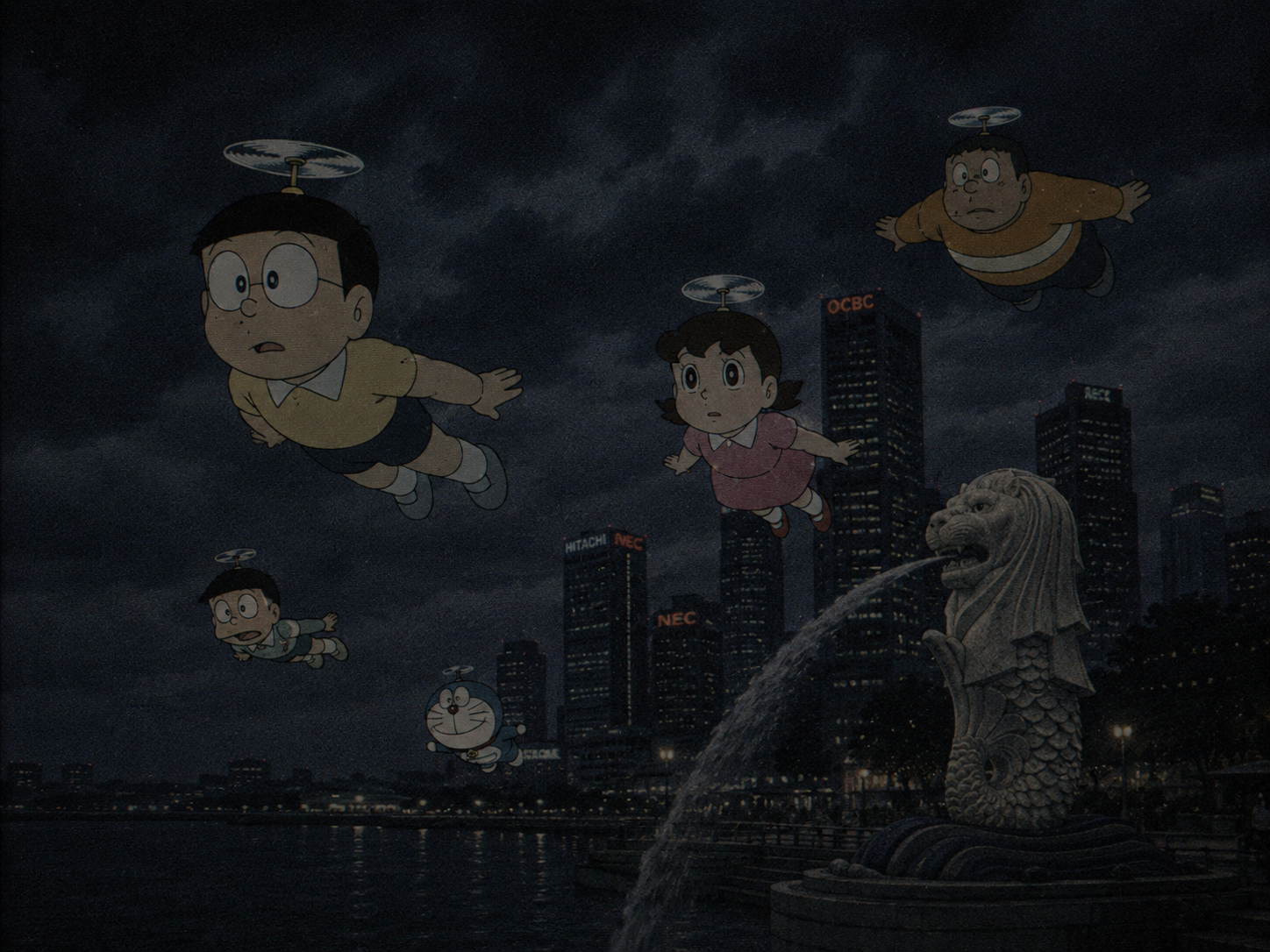
There is a specific category of internet artifact that produces unease not through gore, nor through explicit threat, but through the quiet wrongness of corporate amnesia. The Singapore Doraemon thumbnail belongs to this category. It is cheerful. It is official. And no one—not its publisher, not its distributor, not the conglomerate that owns the intellectual property—can tell you where it came from.
That is the clinical problem. The psychological one is more interesting.
The Cultural Anatomy: A Promotional Ghost from the Era of Physical Distribution
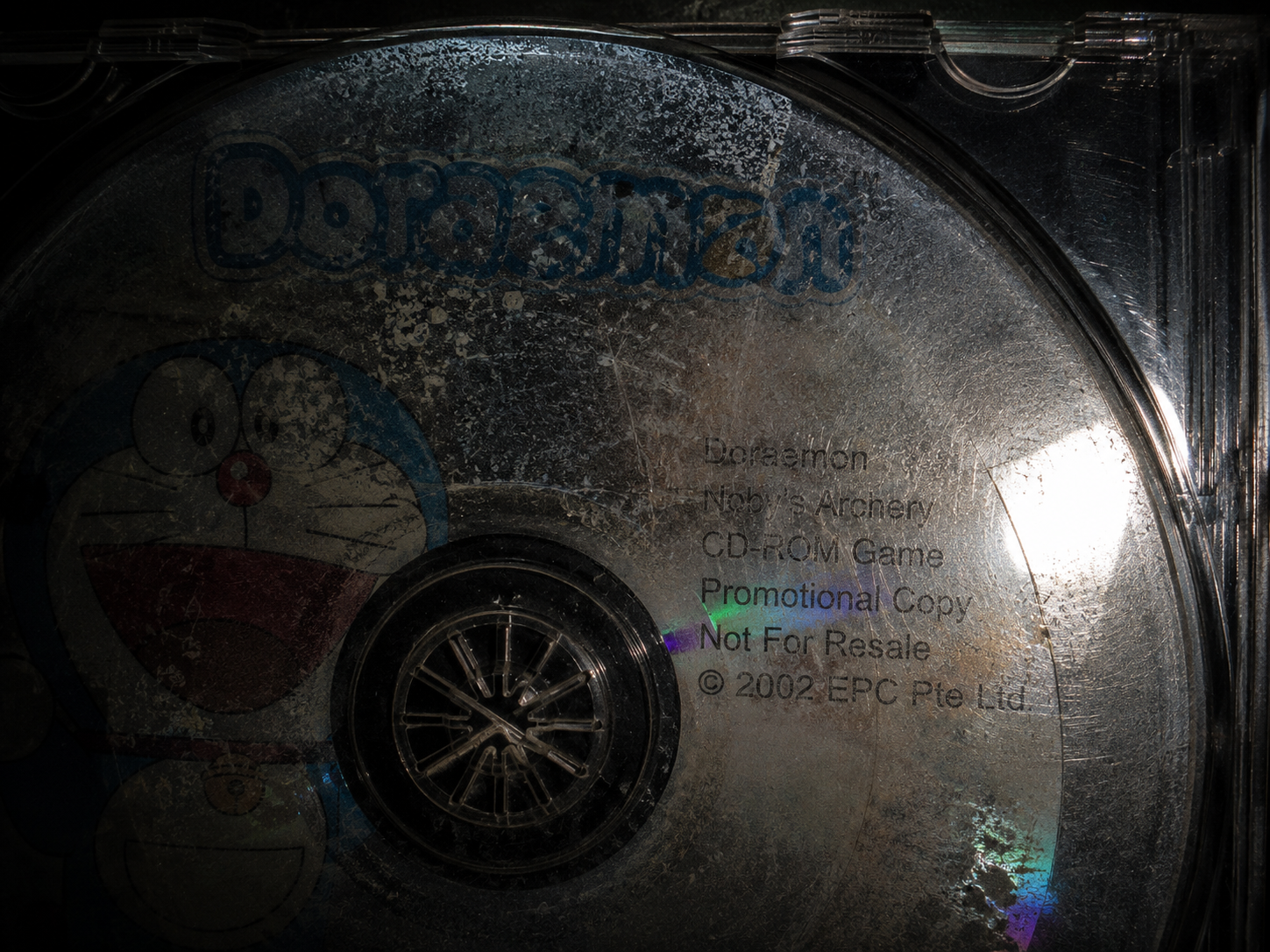
To understand the Singapore thumbnail’s ontological status, one must first understand the mechanics of late-20th-century media distribution in East Asia. Shogakukan, the Japanese publishing house that holds the Doraemon intellectual property in partnership with Shin-Ei Animation, operated within a licensing ecosystem that was, by contemporary standards, profoundly careless. Promotional assets—character illustrations, localized banners, merchandise templates—were distributed to regional partners via physical media: CD-ROMs, floppy disks, press kits assembled without metadata standards or centralized archiving. A regional broadcaster in Seoul received the same treatment as one in Bangkok or Jakarta. The materials arrived; the materials were used; the materials were never catalogued with any expectation of future accountability.
Daiwon Broadcasting (대원방송), the Korean licensee responsible for airing Doraemon during the 1990s, operated a promotional website in the early 2000s. It was the kind of website that defines a specific stratum of internet archaeology: low-resolution headers, tiled backgrounds, frames-based HTML. On this now-defunct domain, investigators conducting crowd-sourced research found the Singapore illustration officially hosted—embedded in the site’s promotional architecture as though it were a routine asset. It also surfaced on licensed Korean merchandise from the same decade, confirming the image’s legal legitimacy. This is not fan art. This is not a forgery.
The illustration itself is compositionally specific in ways that matter forensically. Doraemon and his companions—Nobita, Shizuka, Gian, and Suneo—fly via Takecopters over an unmistakable skyline. The Merlion is visible in its pre-2002 location, before the statue was relocated from the mouth of the Singapore River to a dedicated park. The Anderson Bridge sits in the background with a precision that is, frankly, unnerving in retrospect. Someone commissioned this image with deliberate geographical specificity. A real city. A real harbor. A real historical moment—frozen.
And then Shogakukan forgot it existed.
Structural Dissection: Anomalies in the Signal
In 2007 or 2008—the exact date is lost, which is itself symptomatic—a user uploaded a YouTube video. The audio track was “Suneo’s Bragging Theme” (スネ夫가 자먼화를 할 때에 흘러나오는 곡), a jazz-funk instrumental composed by Shunsuke Kikuchi and first broadcast in 1979. The thumbnail chosen for this upload was the Singapore illustration.
The video accumulated millions of views.
This is the mechanism through which the image achieved its current cultural status, and it is worth pausing on the precise strangeness of that mechanism. A single anonymous curatorial decision—one person selecting one image as a placeholder for one audio upload—permanently fused a piece of promotional material with a meme identity. The track itself was already culturally loaded: in East Asian internet communities, Suneo’s Theme had evolved into the de facto soundtrack for “rich kid” humor, a musical shorthand for conspicuous consumption and performative braggadocio. Suneo (비실이 in Korean), Nobita’s perpetually smug, economically privileged classmate, was already a meme archetype. The thumbnail locked an obscure regional promotional illustration into that identity permanently.
The anomaly is not the meme. Memes are explicable. The anomaly is the one-way gate: the image entered the cultural record through the YouTube upload and cannot be traced backward through it. No upload log survives. No source citation was ever provided. The original uploader did not indicate where they obtained the file—whether they ripped it from the Korean website directly, retrieved it from a merchandise scan, or received it through a file-sharing network that no longer exists. The chain of custody is severed at the upload event.
When researchers from Japanese archiver communities—including contributors to the NicoNico Douga Encyclopedia, which functions as a rigorous repository for Japanese media history—attempted to trace the illustration to a primary Japanese publication, they found nothing. No magazine feature. No promotional booklet. No press kit inventory. The image’s original Japanese debut, if it had one, is a blank slate.
What remains is a secondary confirmation of legitimacy—the Korean web hosting, the merchandise appearances—without a primary source. In forensic terms, this is evidence that proves existence while being categorically unable to prove origin.
Psychological Necropsy: Why This Disturbs the Western Mind
The cultural reception of the Singapore thumbnail diverges sharply along geographic lines, and this divergence is analytically revealing.
In East Asian and South Asian internet subcultures, the image generates nostalgic warmth edged with ironic humor. Suneo’s Theme is funny. The thumbnail is funny. The investigation into its origin is treated as an entertaining puzzle—a community archaeology project with affectionate stakes. The laughter is genuine; the mystery is charming.
Western communities respond differently. On the Lost Media Wiki, in r/AnalogHorror adjacent spaces, in YouTube video essay comment sections, the Singapore thumbnail occupies a psychological register closer to dread. The reaction is not one of puzzle-solving enthusiasm but of something more visceral—a response to what the image represents structurally rather than what it depicts literally.
This divergence requires explanation, because the image itself is unambiguously cheerful. Cartoon children fly over a sunny harbor. There is no horror iconography present.
The disturbance is cognitive, not visual. Western internet culture has developed a specific sensitivity to what might be called “corporate liminality”—the state of being an object that is simultaneously official and orphaned. The Singapore thumbnail triggers this sensitivity with unusual precision because it violates a foundational assumption about how intellectual property works: that a multi-billion dollar franchise maintains comprehensive awareness of its own promotional output. Doraemon is not an obscure property. It is one of the most commercially significant media franchises in Asia; its licensing apparatus is extensive and professionally managed. The existence of an officially licensed image that its own corporate owners cannot account for introduces a category error.
The Merlion’s pre-2002 positioning compounds this effect. The Singapore skyline depicted in the illustration corresponds to a historical moment that no longer physically exists—the harbor has been reconfigured, the statue relocated. The image is therefore not merely unaccounted for; it depicts a version of reality that has been superseded. This is the visual grammar of the liminal: a recognizable place rendered uncanny by temporal displacement.
The psychological mechanism here is the same one that makes photographs of demolished buildings unsettling. The object in the image is real; the reality depicted no longer exists; and the document connecting them has lost its institutional context. The Singapore thumbnail is an official record of an unofficial moment—corporate media floating free of corporate memory.
The Evidence of Void: Physical Decay and Social Erasure
Two distinct processes collaborated to produce the thumbnail’s lost status, and they should not be conflated.
The first is material decay—the literal degradation of physical distribution infrastructure. The CD-ROMs and press kits through which Shogakukan distributed promotional assets to regional licensees in the 1990s were not designed with archival permanence in mind. They were operational tools. When the operational period ended, the materials were not systematically digitized or catalogued. Physical media degrades; institutional memory, without active maintenance, does the same. The gap in Shogakukan’s corporate record is not evidence of malfeasance; it is evidence of the standard practices of an industry that did not anticipate needing to reconstruct its own ephemera.
The second process is social erasure—the quiet disappearance of early web infrastructure. The Daiwon Broadcasting website that hosted the image no longer exists. It was not archived comprehensively by the Wayback Machine; the early-2000s Korean web is, broadly speaking, poorly represented in international archival databases. This is a known gap in digital preservation. English-language and American-web resources were disproportionately captured during the formative years of web archiving; Korean, Japanese, and Chinese internet infrastructure from the same period was archived with significantly less consistency.
The Newsis watermarks discovered during the investigation—cropped assets and localized banners from the Korean domain bearing the stamp of a Korean news agency—suggest an additional layer of institutional complexity. Newsis operated as a licensed aggregator distributing media assets to affiliated outlets; its watermarks appearing on Doraemon-related web materials implies a chain of re-licensing and redistribution that has itself gone undocumented. These watermarked assets have subsequently become surrealist shitpost material in East Asian online communities—a second-order meme ecology built on the ruins of a first-order archival failure.
The combination of physical decay and infrastructural under-archiving created conditions in which a legitimate, widely-distributed commercial asset could achieve functional “lost” status while remaining technically accessible as a digital file. The file exists. Its context does not.
The Point of No Return: A Final Uncomfortable Insight
Here is the most unsettling conclusion the evidence supports: the Singapore thumbnail is not exceptional.
It is, in all likelihood, representative.
The promotional apparatus of late-20th-century media—the regional press kits, the licensed website assets, the merchandise graphics distributed on physical media to partners in a dozen countries—operated at a scale and speed that made comprehensive archiving structurally impossible. Shogakukan was not uniquely negligent; it was operating normally within an industry whose standard practices did not include the assumption that every piece of promotional output would eventually require forensic reconstruction.
What changed is not the behavior of media corporations. What changed is the internet’s capacity to surface, preserve, and scrutinize ephemera. A single upload—one anonymous YouTube video with millions of views—inserted a commercial ghost into the permanent record of internet culture. The image now has more cultural visibility than it ever possessed during its operational lifespan as a regional promotional asset. And yet it remains, structurally, a ghost: present in the record without provenance, authenticated without origin, official without institutional acknowledgment.
Digital memory is not neutral archiving. It is the default archive of human experience. This shift creates an illusion of complete documentation. However, the survival of any specific artifact remains governed by the curatorial decisions of anonymous individuals, the survival patterns of early web infrastructure, and the meme dynamics of communities that were not the original audience. The Singapore thumbnail survived because someone thought it looked right for a jazz-funk bragging theme. Other images—equally official, equally legitimate, distributed through the same physical channels to the same regional licensees—did not survive. They are not lost media in any detectable sense; they are simply gone, without the YouTube upload that would have given them a second life.
The corporate amnesia that produced this artifact is not a mystery to be solved. It is a structural condition to be understood. And the discomfort the image produces—across its varying cultural registers, from nostalgic warmth to analog horror—is the appropriate emotional response to a fundamental truth about how human institutions manage their own output: carelessly, incompletely, and with a confidence in future irrelevance that the internet has systematically proven wrong.
Somewhere in a defunct press kit, in the file structure of a CD-ROM no one kept, is the artist’s name. A date. A client brief explaining why a Japanese children’s cartoon needed to be depicted flying over Singapore’s pre-reconfiguration harbor.
That information is not coming back.
🔍Search Update: Call to Action
The 3AM Archive is officially opening a collaborative file trail for Western lost media researchers, data archeologists, and East Asian broadcast historians. If you possess physical Korean or Japanese Doraemon promotional CD-ROMs (1995–2002), licensed regional merchandise catalogs, or unindexed back-ups of early Daiwon Broadcasting domains, we require your data. Do not let corporate decay dictate the boundaries of digital preservation. Contact our research desk or submit your findings to the community log below.
This document is an investigative archival reconstruction based on fragmented public records, media remnants, community accounts, and verified historical sources compiled by The 3AM Archive.
The article examines how incidents, forgotten media, internet folklore, and unresolved public memories evolve through cultural preservation and digital decay.
This is a cultural investigation document — not fictional horror content.
All visual materials used in this post are exclusive AI-generated assets created for The 3AM Archive.
