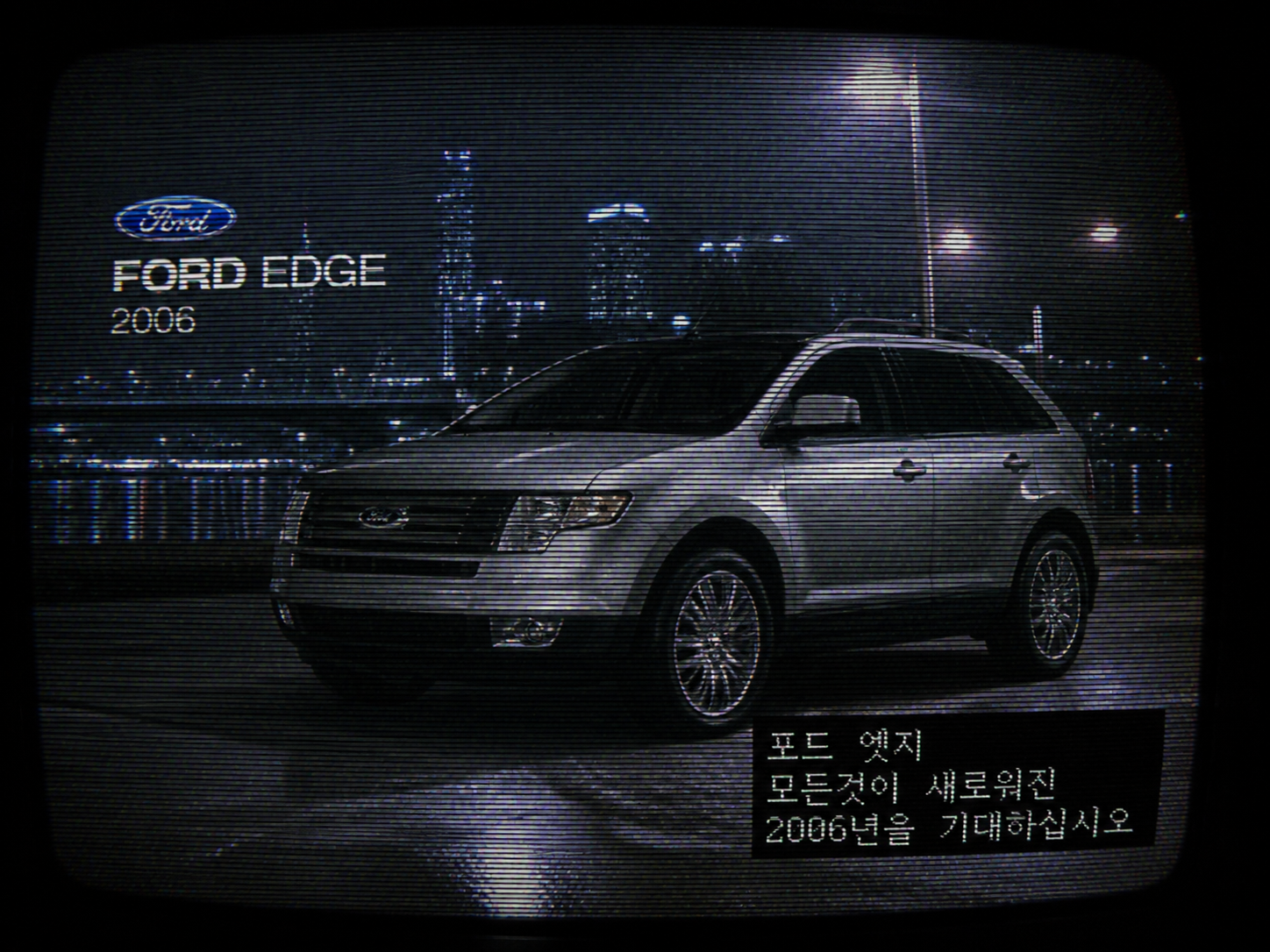
There is a specific category of unease that belongs entirely to the early-2000s corporate media landscape—a sensation distinct from horror, closer to vertigo. It arrives when you discover something was made, something was distributed, something was watched inside specific living rooms in specific zip codes; and then, with the bureaucratic efficiency of a quarterly budget review, it ceased to exist. No ceremony. No explanation. The asset simply passed out of the archive and into the void.
The 2007 Ford Edge multilingual commercial campaign is that sensation, crystallized.
It does not haunt because it is disturbing. It haunts because of what its disappearance reveals about the infrastructure of manufactured desire—the way a Detroit corporation could commission a Korean pop idol to sing a decade-old ballad about eternal love, repackage that ballad into three linguistic variants, pipe it into diaspora households during odd broadcast hours, and then let the entire apparatus dissolve. No master tape. No regional recording. No raw digital audio file of the re-tracked vocals. Only a paper trail in contract language; a ghost made of ink.
The Cultural Anatomy: An Era Built on Invisible Walls
To understand why this commercial existed at all, you have to understand 2006—specifically, what American automotive marketing understood about demographic segmentation at that moment.
The mid-2000s represented a mature, if underexamined, phase in targeted ethnic media. The infrastructure of Korean-American, Chinese-American, and Vietnamese-American broadcast television—cable access channels, satellite packages, local-frequency ethnic broadcasters—had been commercially viable for years. Advertisers knew the geography of these signals. They knew that a Koreatown household in Los Angeles might watch programming that a household three blocks outside that neighborhood would never encounter. They built campaigns accordingly.
Ford, entering the market with the first-generation Edge—a newly designed crossover positioned as aspirational but accessible—wanted penetration into those immigrant-household demographics. The logic was blunt: if you speak to someone in their first language, using cultural touchstones that carry emotional weight from the country they left, you generate a different quality of brand association than a generic English-language spot ever could. The multilingual campaign was not sentimental. It was a conversion calculation.
What made the campaign architecturally unusual was the talent selection. Ahn Jae-wook—안재욱—was not an obscure regional figure. He was a Hallyu first wave; a genuine phenomenon whose 1997 drama Star in My Heart had generated the kind of cultural saturation that defines a generation. His ballad “Forever,” written as the drama’s theme, carried an emotional signature so specific to late-1990s Korean pop romanticism that it functions less like a song and more like a memory trigger. In South Korea, hearing those opening minor chord intervals does not merely remind a listener of the drama. It reconstitutes the feeling of watching it—the tragic romance, the melodrama, the specific quality of late-night television sentiment that belonged to that era.
Ford licensed a localized remix of this song. The contract was signed in December 2006.
Structural Dissection: The Anomalies in the Signal
Here is where the case becomes genuinely strange—where the archival record develops the particular texture that attracts forensic attention.
The campaign ran for approximately six months across digital and broadcast channels. Given the media landscape of 2007, that duration implies a substantial quantity of physical and digital artifacts: master tapes, broadcast logs, station dubs, possibly digital ad server files if any placement was online. Three linguistic variants—Korean, Mandarin Chinese, Vietnamese—means at minimum three separate vocal recording sessions, three sets of production assets, potentially three sets of broadcast masters.
None of it surfaced.
This is not unusual, precisely—broadcast ephemera from the mid-2000s vanishes routinely. Station archives are expensive to maintain; corporations do not preserve assets with no ongoing commercial value; tape degrades. The physical explanation is credible. What makes this case structurally anomalous is the combination of factors working simultaneously against recovery.
First, the targeted distribution model ensured that the commercial aired in a bounded demographic space. English-speaking households were not the audience; English-speaking media archivists, broadly speaking, were not watching these channels. The community most likely to have recorded the commercial—Korean-American viewers with VHS or early DVR equipment—represents a population that archives personal recordings in personal spaces, not institutional ones. The material may exist in a box in a garage in Koreatown. It is not on YouTube.
Second, the Hallyu context creates a peculiar asymmetry. Korean media archaeologists—researchers who have done extraordinary work recovering lost broadcasts, drama clips, and variety show recordings from the 1990s—were not looking for a Ford commercial. Their archival attention orients toward Korean-produced content. A mid-2000s American automotive spot, however resonant its soundtrack, does not register as a recovery target within that community’s institutional logic.
Third, and most quietly: Ford had no commercial incentive to preserve it. The campaign served its purpose and was retired. The master assets were almost certainly not transferred to long-term archival storage. They degraded, or they were deleted, or they sit in an unparsed legacy server somewhere behind a corporate firewall that no one has reason to open.
Psychological Necropsy: Why the Western Mind Finds This Disturbing
The r/lostmedia community has a precise appetite for a specific flavor of missing media—one that involves intentional construction followed by structural disappearance. A home video that was never meant for wide distribution going missing is merely sad. A piece of media that a corporation engineered, distributed at scale, and deliberately targeted at a population subgroup going missing triggers something more conceptually unsettling.
What the Western media archaeologist encounters, arriving at this case without Korean cultural context, is an object that behaves like an accidental Alternate Reality Game. The text record confirms that a specific piece of engineered media existed. The search for that media returns nothing. The content that media contained—a Korean idol singing a ballad titled “Forever,” in three languages, over footage of an American crossover SUV—sounds, stripped of its context, like something a generative AI might hallucinate when asked to describe “unsettling corporate ephemera.”
The song title compounds this. “Forever” is a syntactically simple English word that, in its original Korean cultural context, refers to the specific forever of melodramatic romance—temporary by definition, catastrophically sincere in the moment. Deployed as the sonic backdrop of a Ford commercial targeting diaspora households, it acquires a different semantic register. It sounds like a corporation making a promise it was constitutionally incapable of keeping, set to music specifically engineered to make the listener feel the weight of promises in general. The melancholic minor chord progression, noted in the original fact sheet, does not soften this reading. It intensifies it.
Western audiences encountering this via the lost media lens—through the lens of analog horror aesthetics, through the vocabulary of liminal spaces and corporate uncanny—are responding to something real, even if they’re misidentifying its source. The discomfort is not supernatural. It is structural. It is the recognition that entire pockets of media were manufactured for people who were not you, airing in spaces you could not access, in languages you did not understand, and that those pockets have been scrubbed so thoroughly that only the contract language remains.
The Evidence of Void: Physical Decay Versus Social Erasure
There are two distinct mechanisms by which media disappears, and they require different forensic responses. Physical decay—magnetic tape deterioration, server deletion, data corruption—leaves an absence that is in principle recoverable; somewhere, a copy might exist. Social erasure—the collective failure to recognize something as worth preserving—leaves an absence that is functionally permanent, because the conditions that would have generated preservation never existed.
The Ford Edge commercial sits at the intersection of both mechanisms, which is precisely what makes its absence so stable.
On the physical side: the mid-2000s represents a genuinely difficult archival era. Digital preservation workflows were not standardized. Broadcast station archives were inconsistent. The transition from tape-based to digital-native production was ongoing; assets existed in hybrid formats that were difficult to migrate and easy to lose. A six-month campaign from 2007, produced in three linguistic variants for targeted ethnic broadcasting, would have required institutional commitment to preserve—and there was no institution with a stake in preserving it.
On the social side: the segmentation that made the campaign commercially rational also made it archivally invisible. Korean-American households watching the commercial in 2007 were not, as a population, tagging their recordings with metadata designed to surface in future media archaeology searches. Vietnamese-American and Chinese-American households similarly. The content was not considered culturally significant at the time, which is the exact condition that leads to permanent archival gaps; significance-at-the-time is the primary driver of preservation behavior.
What is left is pure text. A contract record. A press mention. The factual skeleton of a thing that once had audio and image and emotional affect, reduced to the assertion that it existed.
The Point of No Return: On Digital Memory and Designed Forgetting
The Ford Edge tape—this is the name it deserves, though no physical tape is confirmed to exist—represents a category of media that should not have been capable of disappearing in the early-2000s media environment. This was not the 1950s. Digital copies were, in principle, cheap to make and easy to store. The infrastructure of reproduction was available.
And yet.
The case forces a revision of the comfortable assumption that digital media is intrinsically more durable than analog media. Durability, it turns out, is not a property of the storage format. It is a property of who wanted to keep it. Film archives are maintained because someone decided film was worth maintaining. Television archives, such as they are, exist because broadcasters had occasional regulatory and commercial reasons to retain material. Digital assets persist when they are backed up to redundant systems by institutions with reasons to perform that backup.
Targeted ethnic media in 2007 had no such institutional advocate. It existed in a distributed, fragmented broadcast ecosystem; it was consumed by audiences whose archival infrastructure was personal rather than institutional; and it was produced by a corporation whose interest in the asset ended the moment the campaign concluded.
The Ford Edge commercial, in this reading, is not a mystery. It is a demonstration. It demonstrates that designed media—media engineered with forensic precision to reach a specific population, to leverage a specific cultural memory, to generate a specific emotional response—can be designed to disappear just as precisely. Not through any active suppression; Ford was not burning tapes. Through the simple mechanism of making something for people the archive was not watching, and then declining to preserve it themselves.
Ahn Jae-wook’s voice, singing “Forever” in three languages over footage of a steel American crossover, aired inside specific living rooms during specific hours of specific broadcast days in 2007. Some number of Korean-American, Chinese-American, and Vietnamese-American viewers heard it and felt, for a moment, the minor-chord weight of a song they associated with something other than automotive marketing. Then the campaign ended. The assets were not preserved.
What remains is the record that it happened; and the record’s stubborn refusal to become the default archive of human experience. The comfortable myth that the internet captures everything acts as a blindfold. In reality, modern history is riddled with intentional corporate blind spots where localized culture goes to die.
The tape is gone. The void is the evidence.
🔍Search Update: Call to Action
The 3AM Archive is officially opening a peer-to-peer data recovery request for the 2007 Ford Edge Multilingual Commercials (Korean, Mandarin, and Vietnamese variants).
We are urging Western media archeologists, off-air archivists, and members of the East Asian diaspora who recorded ethnic broadcast television packages (such as International Channel Shanghai, TV Asia, or local cable access signals) between December 2006 and June 2007 to check their physical media collections. If you possess unindexed VHS home recordings, early Tivo/DVR hard drive backups, or master station dubs from this exact window, you hold the key to reconstructing this missing historical signal. Contact our forensic inbox or submit coordinates via our secure repository. Do not let corporate indifference dictate the limits of our collective memory.
This document is an investigative archival reconstruction based on fragmented public records, media remnants, community accounts, and verified historical sources compiled by The 3AM Archive.
The article examines how incidents, forgotten media, internet folklore, and unresolved public memories evolve through cultural preservation and digital decay.
This is a cultural investigation document — not fictional horror content.
All visual materials used in this post are exclusive AI-generated assets created for The 3AM Archive.
